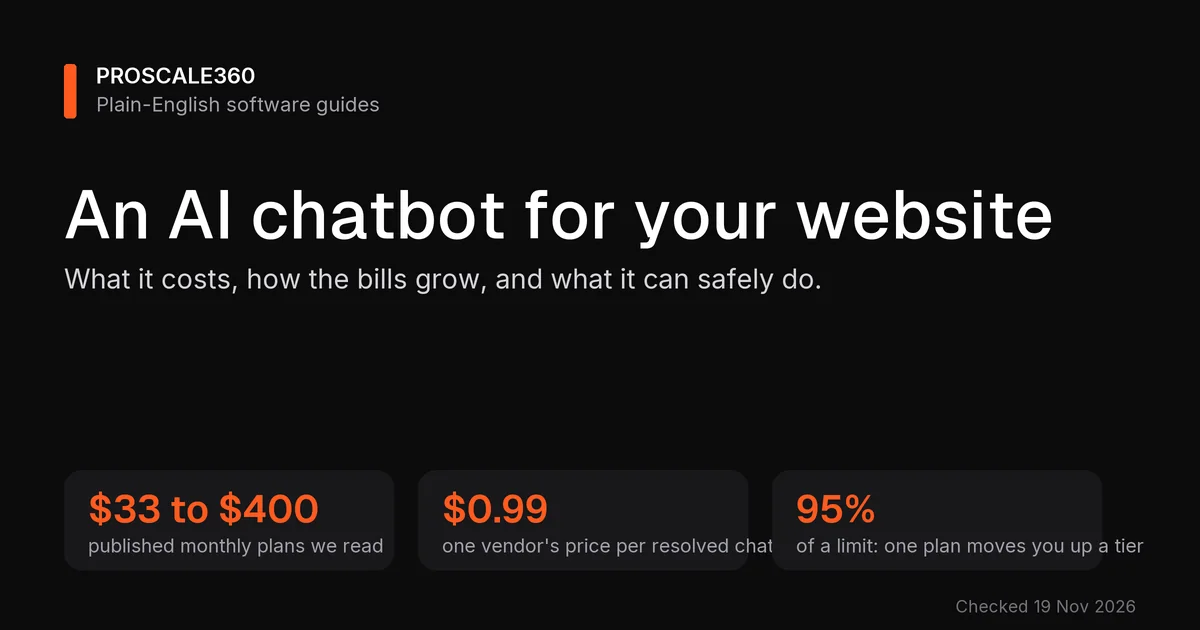
The short answer. The monthly plans we read run from $33 to $400 before extras, and they charge in three different ways: a plan with a quota, a price for each resolved chat, or credits. The bill that surprises people is the one that grows when you get busy. A chatbot is safest when it answers only from your own pages, says it is an AI and hands over to a person.
Who this is for. A small business owner who has been told a website chatbot will save time, and wants to know what it really costs and what could go wrong before paying.
Sourced means we read the vendor's own page on 19 November 2026. Our arithmetic is our own sum. Our estimate marks our judgement. None of the vendor pages we read gives a currency code or an effective date.
Words used in this post
Chatbot: a box on your website that chats with visitors.
Conversation: one visitor chatting with the bot from start to finish. Vendors count it in different ways.
Resolved: the bot answered and the visitor did not need a person. Each vendor defines it in its own way.
Credit: a unit some vendors sell. How many credits one reply uses depends on the vendor and the model.
Who this post helps
- Shop owners who answer the same questions all day. Opening hours, delivery and returns can be answered from your own pages, with a person for the rest. See the five checks below.
- Clinics, salons and tradies who miss enquiries after hours. A bot can take a name and a question for follow-up. Keep it away from advice and health details.
- Owners comparing Tidio, Intercom Fin or Chatbase. The table shows how each one charges, and the worked example shows why the busiest month matters.
- Owners worried about wrong answers or privacy. Limit the bot to your own pages, label it as an AI and read real chats for the first month.
What a website chatbot does, in plain words
A website chatbot answers visitors' questions at any hour. The older kind follows a fixed script. The newer AI kind reads your pages, such as prices, opening hours and policies, and writes an answer in its own words. That second kind can sound very sure of itself even when it is wrong, which is why the safety half of this post matters as much as the price half.
Three ways vendors charge
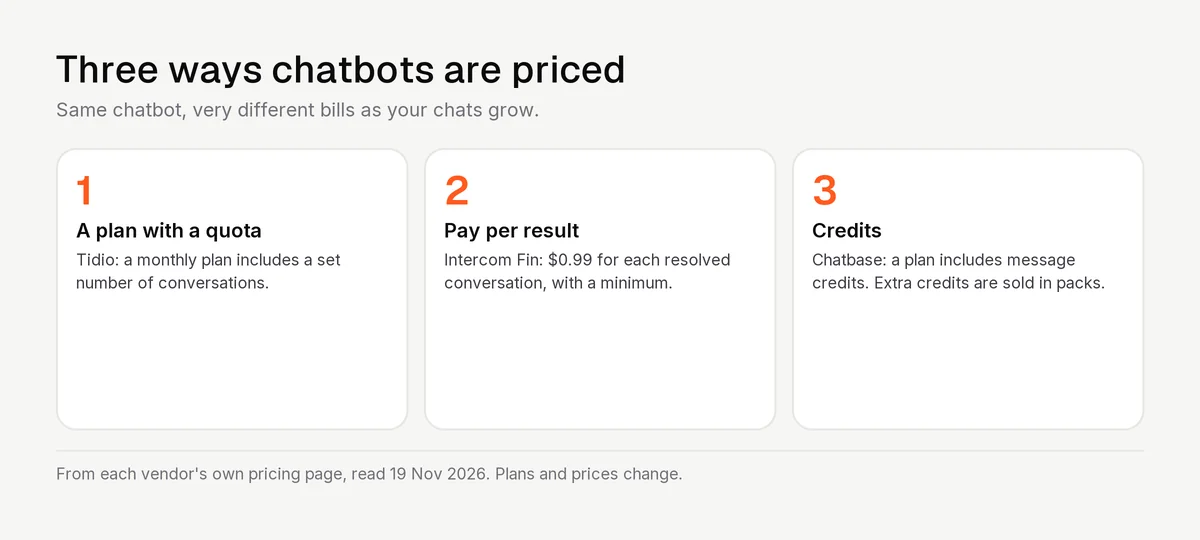
| Vendor | What the page shows | The catch on the page |
|---|---|---|
| Tidio | Starter $33 a month billed annually ($390 a year) for 50 AI and human conversations. Growth from $63 a month ($750 a year), 100 conversations, up to 1,000 with the selector. Plus from $300 a month plus usage. | At 95% of a limit it moves you to the next tier and you pay that tier's price from then on. The AI and human conversations share one quota. |
| Intercom Fin | $0.99 per outcome. A minimum monthly commitment applies, for example 50 outcomes. | You are charged at most once per conversation, and not if Fin cannot answer or the visitor asks for a person. Seats for Intercom's own helpdesk are extra: $19 a month per seat on Essential for new customers, $85 on Advanced, $132 on Expert. |
| Chatbase | Basic $120 a month billed yearly for 4,000 message credits and 1 agent. Business $400 a month billed yearly for 15,000 credits. | More credits are $40 per 1,000. Removing the 'Powered by Chatbase' label is $99 a month. Extra agents are $25 each a month. |
The limits. These are three vendors out of dozens, chosen because they show three different ways to charge. Third-party comparison blogs disagreed with each other on these same prices, so we used only the vendors' own pages. Prices and promotions change.
A worked example: 400 chats a month
Take a small shop that gets 400 chats a month. This is an invented example to show how the pricing models behave. Our assumption, not a measured figure: the bot fully answers 60% of them, which is 240 chats.
- Pay per result (Intercom Fin, used on its own): 240 × $0.99 = $237.60 a month. A quiet month costs less and a busy month costs more, with no ceiling. The fee only counts conversations Fin resolved.
- Credits (Chatbase Basic): $120 a month for 4,000 credits, which is 10 credits per chat at 400 chats. Whether that is enough depends on how many credits each reply uses. We did not find that on the pricing page, so ask. Extra credits are $40 per 1,000.
- A plan with a quota (Tidio): 400 conversations is beyond the 100 that Growth shows by default. The page says Growth goes up to 1,000 with the selector but does not show the price at 400, so get a written price before you rely on it.
Our arithmetic The point is not which one wins. It is that the same shop can see a bill that is steady, one that moves with every chat, or one that depends on a number you cannot see on the page.
The auto-upgrade trap
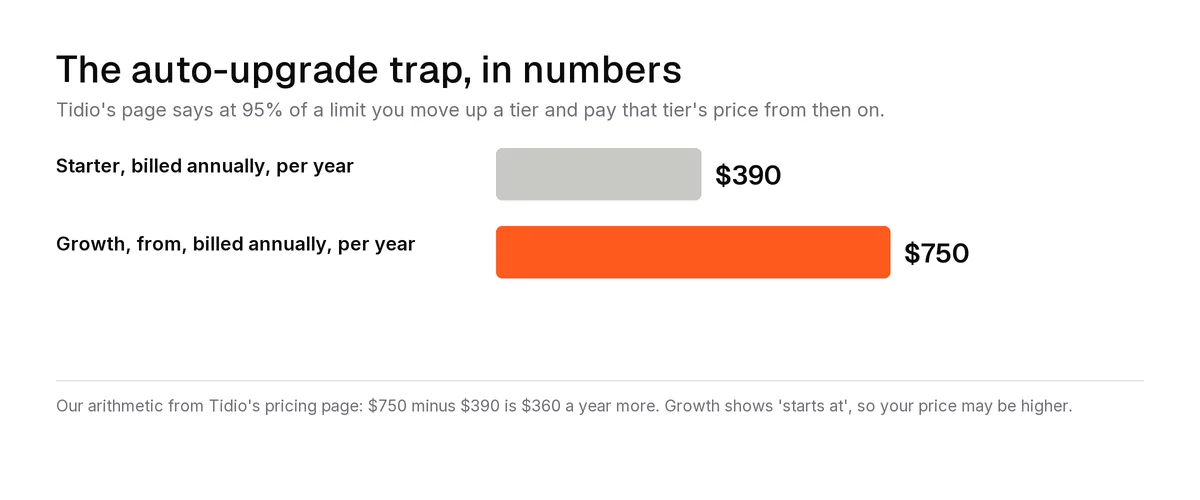
Tidio's page says that when you use 95% of a limit, your plan moves up to the next tier and you pay that tier's price from then on. Picture a shop on Starter, with 50 conversations a month. One busy week, a sale or a social media post, and a month passes the 95% mark. If it lands on Growth, $750 minus $390 is $360 more a year, and the page's wording suggests it does not step back down on its own. Check that with the vendor before you sign.
The same idea shows up elsewhere in a different form. Pay-per-result prices rise with every busy day. Credit plans charge $40 for every extra 1,000. None of these is dishonest. They are the reason to ask, before you start: what happens to my bill in my busiest month?
What it can safely do, and what it should not
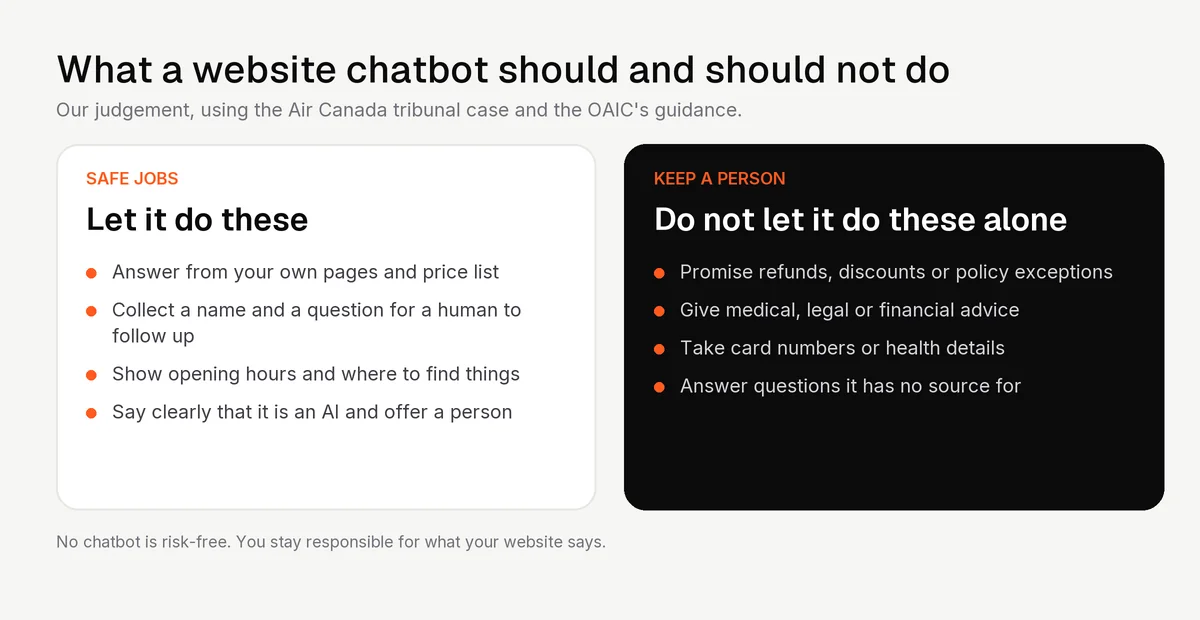
You are responsible for what the bot says. In a 2024 case in British Columbia, Canada, a tribunal held Air Canada liable after its website chatbot gave a customer wrong information about a bereavement fare. The airline had argued the chatbot was a separate entity responsible for its own actions, and the tribunal rejected that. The customer was awarded $650.88 in damages. The limits: this is a Canadian tribunal decision, not Australian law, and we read summaries of it, not the decision itself. It shows how a regulator or a court may think about a bot on your website.
Privacy. Australia's privacy regulator, the OAIC, published guidance on 21 October 2024 on using commercial AI products. It is not binding. It says privacy obligations apply to personal information put into an AI product, recommends against entering personal information into public AI tools, and says public-facing chatbots should be labelled as AI. The limit: we read the OAIC page and summaries, not every line of the guidance.
From this, our rules of thumb (Our estimate):
- Let it answer only from your own pages, and tell it to say 'I am not sure, here is how to reach a person' when it has no source.
- Say it is an AI at the start of the chat.
- Never let it promise refunds, discounts or exceptions, or give medical, legal or financial advice.
- Do not ask visitors for card numbers or health details in the chat.
- Read a sample of real chats every week for the first month.
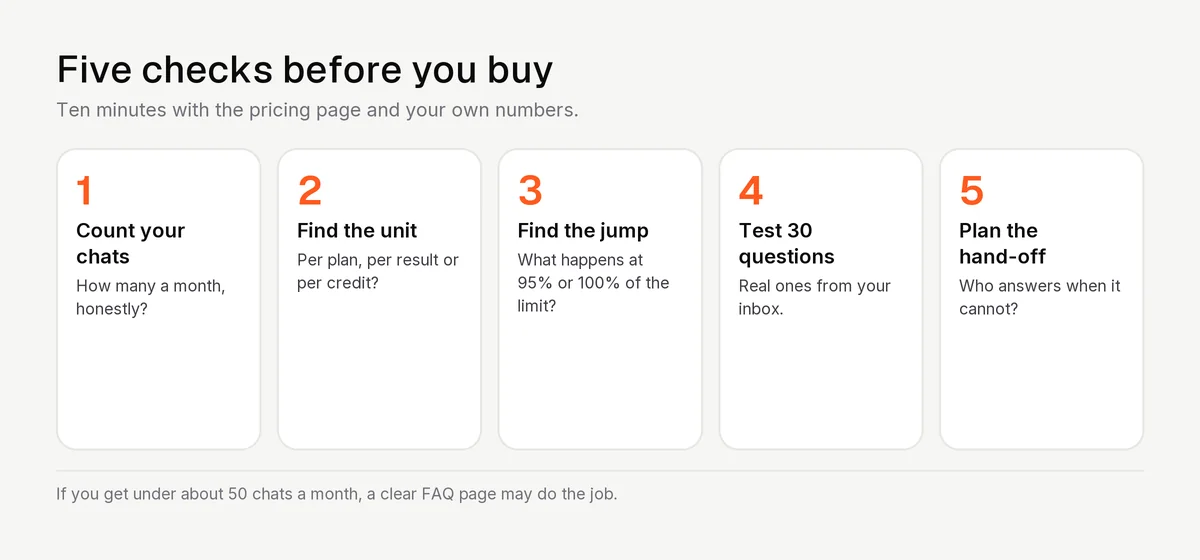
Five checks before you buy
When you probably do not need one
If your website gets fewer than about 50 chats a month, Our estimate a clear FAQ page, an obvious phone number and a WhatsApp link may serve visitors better than a bot, and cost nothing a month. Chatbots earn their keep when the same questions arrive often, at hours you are not working.
How Proscale360 can help
Proscale360 is a founder-led, remote-first studio: Alif Vasaya, a marketer in Sydney, and Sabina Ansari, a senior full-stack engineer and tech lead in Ahmedabad.
We want to be the go-to contact for any IT work, priced as clearly as a supermarket shelf. We take the risks. You get the result.
Founder account Between them, our founders have built integrated systems from scratch to live, including project management, ServiceNow, AI integration, and data collection and analysis, and Sabina has eight years of experience leading software projects. That is our own statement and is not independently verified. What we can show you is counted: see the ProteinPlus and Juhapura Mart case studies.
We have not published a price for website chatbots. If you want an assistant that answers only from your own pages, see our AI integration work, and tell us how many chats you get and which questions repeat. We will say if a ready-made tool is the cheaper answer. If your site has an admin and an API, this post explains how an AI assistant can work with it safely. Give us one task and review the working result. If you are happy, you pay. If you are not, you pay nothing. If you like it and want it better, you pay for our effort plus $10 for a round of tweaks and one meeting. The pilot page has the terms.
The evidence against us, and who we are not for
We are new and founder-led. There are two of us, so capacity has a ceiling, and we have two published case studies, ProteinPlus and Juhapura Mart. We are not the right choice if you need someone in your office five days a week, a 24-hour support team, or a large programme with many specialists at once.
Frequently asked questions
How much does an AI chatbot cost for a small business website?
The vendor plans we read on 19 November 2026 run from $33 a month (Tidio Starter, billed annually) to $400 a month (Chatbase Business, billed yearly), before extras. Intercom Fin charges $0.99 per resolved conversation with a minimum. None of the pages names a currency. Your bill depends on how many chats you get.
What is the auto-upgrade trap?
Tidio's page says that at 95% of a plan limit the plan moves to the next tier and you pay that tier's price from then on. A busy month can raise your price for good. Ask any vendor what happens to the price when you go over.
Can an AI chatbot give wrong answers?
Yes. It can state something wrong in a confident tone. Limit it to your own pages, tell it to say when it is unsure, label it as an AI and review real chats.
Am I responsible for what my chatbot says?
A tribunal in British Columbia held Air Canada liable for its website chatbot's wrong advice in 2024. That is not Australian law, but it shows the risk. Treat the bot as part of your website.
Does Australian privacy law apply to a chatbot?
The OAIC's guidance of 21 October 2024 says privacy obligations apply to personal information put into AI products and that public chatbots should be labelled as AI. It is guidance, not law, and is not legal advice.
Do I need a chatbot at all?
Not always. Under about 50 chats a month, a clear FAQ page and a visible contact option may be enough. That is our estimate, not a rule.
Sources
- Tidio: Pricing, page metadata modified 17 November 2026; read 19 November 2026
- Intercom: Pricing, no date on page; read 19 November 2026
- Chatbase: Pricing, no effective date on page; read 19 November 2026
- McCarthy Tétrault: Moffatt v. Air Canada, misrepresentation by an AI chatbot, a law firm's summary of the February 2024 tribunal decision
- OAIC: Guidance on privacy and the use of commercially available AI products, published 21 October 2024; non-binding guidance
- Proscale360 price list, our own published prices, US dollars
General information, not legal advice. Vendor prices change; we read each page once on 19 November 2026. Prepared by the Proscale360 team with AI assistance.
We specialise in exactly this kind of project. Get a free consultation and a fixed quote.