Information gathered for you, with the sources written down and the rules respected.
Good decisions start with good information. We collect it for you: desk and web research, surveys, research calls, data entry and verification, and enrichment from licensed sources. Every item has a recorded source, and we say plainly what we will not collect.
Is this page for you?
This is for you if you need information gathered for you with the sources written down. By the end of this page you will know what we collect, and what we will not.
We gather information for you from public sources, check it, and hand it back in a clean spreadsheet. A real person reviews it, not only a program.
- Data collection:
- Gathering facts, such as business names or prices, into one list.
- Verification:
- Checking an entry against a second source before it is kept.
- Dataset:
- An organised table of information, one row per item.
- Businesses that need market, price or competitor facts.
Desk and web research from public pages, with source and date recorded.
- Teams that need survey or research-call results.
Surveys and research calls within the Australian rules.
- Owners with messy records.
Data entry, verification, cleaning and enrichment from licensed sources.
Situations we are called for
- You need market, price or competitor facts. Desk and web research from public pages, with source and date recorded.
- Your records are messy. Data entry, verification, cleaning and enrichment from licensed sources.
Questions people ask, answered short
- Do you scrape email lists?
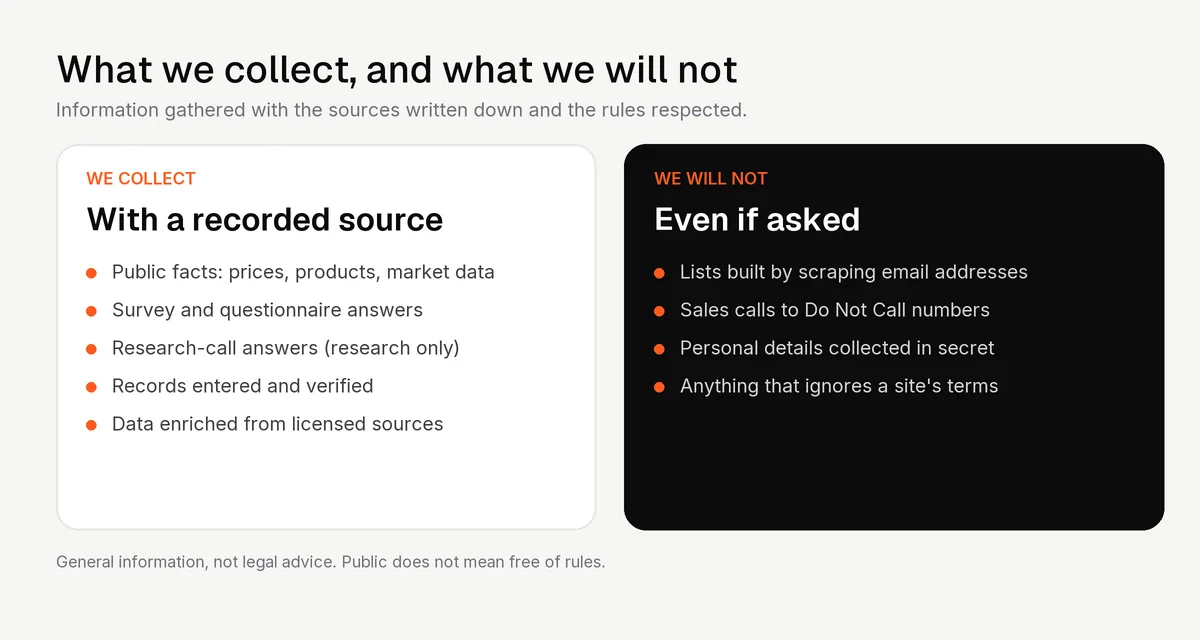
- No. We do not collect scraped email lists, call Do Not Call numbers or collect personal details in secret.
- Do you run surveys?
- Yes, surveys and research calls within the Australian rules.
- How do I know where a fact came from?
- The source and date are recorded for each one.
Us, or something else?
- Do it yourself if it is a small, one-off lookup. Use us for repeatable research with the sources written down.
Not a fit if you want scraped email lists, sales calls to Do Not Call numbers, or personal details collected in secret.
Tell us the question and what the data is for. We reply with a brief, a limits sheet and a quote.
Collecting data is easy to do badly, and some ways of doing it are unlawful
The rules differ for calls, emails and personal information, and public does not mean free of rules.
The Do Not Call Register says researchers can call registered numbers for opinion polling and standard questionnaire-based research, but a call with a commercial purpose, even a secondary one, is telemarketing and cannot go to a registered number.
Limit: From the register's industry FAQ, undated. Exemptions for certain organisations were not verified.
A joint statement signed by the Australian privacy regulator and others says personal information that is publicly accessible is still subject to data protection and privacy laws in most jurisdictions, and that mass scraping of personal information can constitute a reportable data breach in many jurisdictions.
Limit: Read on the Canadian regulator's copy (24 Aug 2023). Aimed mainly at platforms. Not legal advice.
Thomas Redman estimated in MIT Sloan Management Review that bad data costs most companies 15% to 25% of revenue.
Limit: An estimate attributed to other research and consultants, not a measured result (27 Nov 2017).
Where it usually goes wrong,
and what we do instead
Not slogans. Each row is a specific way this work goes wrong, and the specific thing we do about it.
Calls that mix research with a sales pitch, to numbers on the Do Not Call Register.
The purpose of each call is written into the brief. We run research calls only, within the industry standard.
Scraped lists of personal details sold or bought as if they were free.
We collect non-personal facts, record sources and terms, and do not supply lists built with address-harvesting software.
Data nobody can trace.
A source log: where each item came from, when, and under what terms.
Credentials you cannot check.
On request we share a due-diligence pack: the delivery team's credentials, the legal documents that cover the work, the current process, existing client reports and work status, and client references you can call.
Every row rests on a source listed at the foot of this page, with its limits stated beside it. We have not read every review of every provider, so we do not claim to speak for all of them.
Start with the quote, or try one small task first and pay only if you are happy.
What we do
for you
Desk and web research
Facts, prices, competitor and market information from public pages, each with a recorded source and date.
Surveys and questionnaires
Questions designed with you, collected and tidied into a dataset you can use.
Research calls
Standard-questionnaire and opinion-research calls, made within the Australian research-call rules.
Data entry and verification
Records entered, checked against sources and flagged where they do not match.
Cleaning and enrichment
Duplicates removed, fields standardised and records enriched from licensed or public non-personal sources.
A record of provenance
Where each number came from, when, and under what terms.
Step by step,
from brief to result
What you do, what we do, and what you see at each step. You approve the plan and the quote before any work starts.
Agree the question and the limits
Say what you need to know and what you will use it for.
Write down what we will collect, from where, and what we will not collect, including anything involving personal information.
A one-page brief and a limits sheet.
Test with a small sample
Review the first batch.
Collect a small sample, record the sources and flag problems. Happy, you pay. Not happy, you pay nothing.
A sample dataset and a source log.
Collect at scale
Answer questions as they arise.
Collect to the brief, with spot checks and a weekly progress note.
A growing dataset and weekly notes.
Clean and check
Check a sample against what you know.
Remove duplicates, standardise fields and verify.
A cleaned dataset and a check report.
Deliver and document
Approve the dataset.
Deliver in your format with the source log and the terms of use.
The dataset, the log and a handover note.
What you
receive
- A written brief and limits sheet
- A sample dataset and source log
- The full dataset in your format
- A check report
- Provenance notes: source, date and terms
- Weekly progress notes
- A short lessons log: what we learned and changed
What you
can expect
- Information you can trace to its source
- A dataset your team can use without clean-up
- Clarity about what was and was not collected
- Collection that respects the rules that apply
These are what to expect, not guarantees. Results depend on your starting point, your market and the decisions you make. Timings are our founders' experience, and your plan states them before we start.
Experienced people,
in a founder-led, honest studio
We are a new, founder-led studio, and we say so on purpose. The experience behind it is real.
“Our founder Alif Vasaya has spent his career in IT services and outsourcing companies, managing clients and delivery, and the delivery partners we work with have long experience in these fields. That is our own account and is not independently verified, so we offer the due-diligence pack and a trial before you pay.”
Check us
Read the founders' profiles, open our case studies, or run a pilot task before you pay.
Who this is
not for
We would rather say so now than after you have paid.
- You want lists of email addresses built by scraping. We do not supply lists made with address-harvesting software.
- You want sales calls to numbers on the Do Not Call Register. A call with a commercial purpose is a telemarketing call and cannot be made to a registered number.
- You want personal information collected secretly or without a lawful basis.
- You want us to ignore a website's terms and technical limits.
Not sure? Book a free ten-minute call and we will tell you honestly.
Data collection and research:
common questions
We do not publish a price for this work because every project differs. You request a quote and we send one itemised quote that you approve first.
Can you collect data from websites?
Yes, from public pages, with the source and date recorded. Public does not mean free of rules: an international joint statement signed by the Australian privacy regulator says personal information that is publicly accessible is still subject to data protection and privacy laws in most jurisdictions, and that those who scrape it are responsible for complying. We keep to non-personal facts unless a lawful basis is agreed and written down. A website's robots.txt file is a convention crawlers are asked to honour, and RFC 9309 says its rules are not a form of access authorization, so we also read the site's terms. This is general information, not legal advice.
Can you make research or survey calls?
Yes, within the Australian rules. The Do Not Call Register's guidance says market and social researchers can call numbers on the register to conduct opinion polling and standard questionnaire-based research, but a call with a commercial purpose, even if it is not the main purpose, is a telemarketing call and cannot be made to a registered number. Research calls must follow the industry standard on calling hours, identifying the caller and ending the call when asked. We write the purpose of every call into the brief.
Do you sell lists of email addresses or phone numbers?
No. The Spam Act 2003 prohibits supplying, acquiring or using address-harvesting software and lists made with it, subject to exceptions, where there is a link to Australia. We do not supply scraped lists.
What are the penalties for breaking the call rules?
The Do Not Call Register's compliance page says infringement notice penalties range up to $222,000 for each day on which contraventions occurred, and court penalties up to $2.22 million per day. The page is undated, so check the current figures. We mention them because the rules are serious, not to alarm you.
Why does data quality matter?
Thomas Redman of MIT Sloan Management Review estimated that the cost of bad data is 15% to 25% of revenue for most companies. That is an estimate, not a measured result, but it explains why we check and document what we collect.
What does it cost?
We do not publish a price. It depends on the volume, sources and checks, so you receive one itemised quote you approve first, and you can start with a small sample and pay only if you are happy.
Can we verify your team and process?
On request we share a due-diligence pack: the delivery team's credentials, the legal documents that cover the work, the current process, existing client reports and work status, and client references you can call.
Where the facts on this page come from
- Do Not Call Register: Industry FAQs (undated, read 11 Nov 2026)
- Joint statement on data scraping and the protection of privacy (24 Aug 2023; read on the Canadian regulator's copy, signed by the OAIC and others)
- MIT Sloan Management Review: Seizing the opportunity in data quality (Redman, 27 Nov 2017)
- Do Not Call Register: Industry standards, research call rules (undated, read 11 Nov 2026)
- IETF RFC 9309: Robots Exclusion Protocol (Sep 2022)
- Spam Act 2003 (Cth), ss 4 and 20 to 22, address-harvesting software (2016 compilation read; check the current text)
- Do Not Call Register: Compliance and breaches (undated, read 11 Nov 2026)
- OAIC: Australian Privacy Principles quick reference (APP 7 direct marketing, APP 8 overseas disclosure, APP 11 security)
- Proscale360: the pilot, one task, pay only if you are happy
Sources read on 11 November 2026. General information, not legal, tax, security or financial advice. We do not claim cloud-provider certifications or partner status on this page. Rules and prices change, so check the source before you rely on it.
Often needed
alongside this
Tell us what you need.
Get one clear quote.
Describe it in a few lines. A founder reads it and replies with questions or one itemised quote that you approve before any work starts. Prefer to start small? Try the pilot: one task, and you pay only if you are happy.
- CompareAny quote, in our calculator
- Real buildProteinPlus, counted
- $145Website, from
- $0if you're not happy
- $580Online store
- You ownthe code
- 6 stepsHow we work
- AI + peopleAI builds, people test
- Your quote?We price it next to ours
Don't pay 2016 prices for software.
Give us one task. Happy, you pay. Not happy, you pay nothing. We take the risk.
See all nine campaignsWe take the risk
Give us one task. You see a working result before you decide. Happy, you pay. Not happy, you pay nothing.
How you payHow we work
A free call of about ten minutes, a free plan and one itemised quote, a pilot, your review, then go live with support. Six steps, nothing hidden.
See the six stepsPrices you can check
Website from $145. Online store $580. Custom software from $720. Send us any quote you hold and we price the same work next to it. A small upgrade (about an hour of work or less) is about $10.
See the price list“Everything is possible. It doesn't have to cost a fortune, and nothing should hold your ideas back. Things are changing, and you should know it. We have the experience in what we do, so you can do what you're good at: running your business and steering its strategy. You shouldn't have to learn digital marketing or web development, overpay, or wait months, quarters or years for a project to earn revenue.”
“Technology and coding are not as far out of reach as they seem. I have led projects for eight years, and I bring everything I have built and learned to yours. I take care of the details, the security, the updates and the technology stack, so you don't have to worry about any of it.”
In the founders' own words, lightly edited for clarity.
To be the go-to contact for any IT work, priced so clearly it feels as easy as picking something off a supermarket shelf.
We take the risks. You get the result.
Run by Alif Vasaya (Sydney) and Sabina Ansari (Ahmedabad). A new, founder-led studio, and we say so.