Game development capacity for your studio: art, engineering, porting, QA and live-ops.
Most studios hit the same wall: more to build than the team can carry. We supply and manage teams for game development: artists, engineers, QA and live-ops, working in your engine, your pipeline and your build process, under your producers. You see resumes and references first and start with a trial.
Is this page for you?
This is for you if you run a game studio with more to build than your team can carry. By the end of this page you will know what we supply and how platform paperwork works.
We provide game developers and artists on a team basis, from a small prototype to a full release. You keep the rights to what is built.
- Prototype:
- A small playable test to see if the idea is fun before spending more.
- Engine:
- The toolkit, such as Unity or Unreal, that a game is built in.
- Build:
- A version of the game packaged so it can be played or tested.
- Studios that need art, engineering, porting, QA or live-ops capacity.
Teams working in your engine and pipeline under your producers.
- Studios nervous about outsourcing.
You see resumes and references, start with a trial and choose the reporting.
Situations we are called for
- You have more to build than your studio can carry. Teams working in your engine and pipeline under your producers.
- You are nervous about outsourcing. You see resumes and references, start with a trial and choose the reporting.
Questions people ask, answered short
- What can you supply?
- Art, engineering, porting, QA and live-ops capacity.
- Do you own my game?
- No. We do not take on your design or roadmap.
- Do you get me on consoles?
- No. Platform paperwork is yours to complete.
Us, or something else?
- Keep design and the roadmap in-house. Use us for capacity that works under your producers.
Not a fit if you want us to own your game's design or roadmap, or you expect console access without the platform paperwork.
Tell us the engine, the platforms and the roles. We reply with a one-page scope, resumes and a quote.
Outsourced game work fails at the handoffs, not the craft
Art, code and ports usually fail where one party's pipeline meets another's, and where platform paperwork is left to the end.
Microsoft's Xbox publishing page describes registering, signing an NDA, receiving agreements, getting concept approval and passing certification before publishing. The account and access sit with the enrolled studio.
Limit: Xbox only; PlayStation and Nintendo processes were not verified. Agreements override the documentation.
A vendor-written article lists schedule slips, poor frame rate, unstable code, ports with weak controls, certification left to the end and communication gaps as the main risks of outsourcing game work.
Limit: A sponsored article by a vendor. Treat as a self-description, not a survey.
Global games revenue reached $201.6 billion in 2025, with mobile at $113.3 billion, according to Newzoo figures reported by PocketGamer.biz.
Limit: A secondary report of an estimate that Newzoo has revised before. No independent figure for the outsourced share was found.
Where it usually goes wrong,
and what we do instead
Not slogans. Each row is a specific way this work goes wrong, and the specific thing we do about it.
Assets that look right in a viewer and fail in the engine.
Assets are validated in your engine against your budgets before delivery.
Certification discovered at submission.
We plan certification from the start, with access granted by your account holder.
A team nobody on your side can steer.
A single project manager, regular build access and milestone reviews.
Claims about past work that cannot be checked.
On request we share a due-diligence pack: the delivery team's credentials, the legal documents that cover the work, the current process, existing client reports and work status, and client references you can call.
Every row rests on a source listed at the foot of this page, with its limits stated beside it. We have not read every review of every provider, so we do not claim to speak for all of them.
Start with the quote, or try one small task first and pay only if you are happy.
What we do
for you
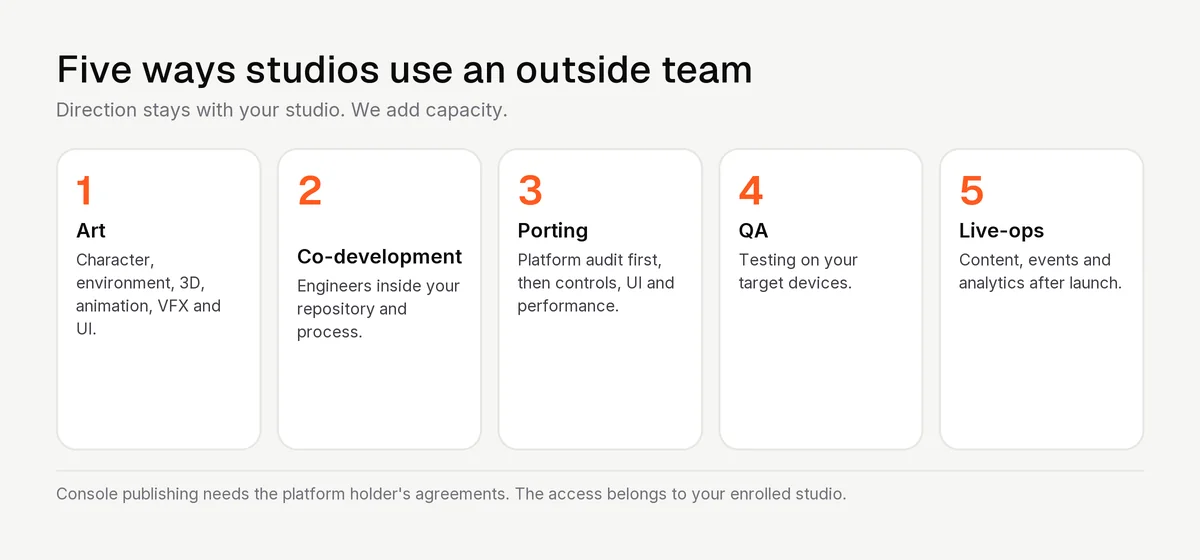
Art
Character, environment and 3D art, animation, VFX and UI, built to your style guide and validated in your engine.
Co-development
Engineers added to your project to carry features, tools or multiplayer work, inside your repository and process.
Porting
A platform audit first, then adaptation of controls, UI, performance and saves for the target platform.
QA
Functional and regression testing on your target devices, with reproducible reports.
Live-ops
Content, events and analytics support after launch, against agreed measures.
A dedicated team
A team that works only on your game, with your priorities, managed day to day by us.
Step by step,
from brief to result
What you do, what we do, and what you see at each step. You approve the plan and the quote before any work starts.
Define the roles and outcomes
Describe the game development work, skills, hours and what good looks like.
Write a one-page role description with outputs, review points and a draft set of KPIs.
A written scope and one itemised quote.
Choose your model
Pick project-based, full-time or contract, and the reporting tools you want.
Explain the trade-offs and write the choice, and how to change it, into the plan.
A named model and reporting routine.
Shortlist and interview
Review resumes and references, and join interviews.
Present vetted candidates and verify references.
People you have approved.
Trial
Give a real, small piece of work.
Run it as a pilot. Happy, you pay. Not happy, you pay nothing.
Real output to judge.
Run, report, review
Read the reports and join target meetings.
Manage the team, report daily, weekly and monthly as you choose, and review the KPIs.
Reports and a review log.
Scale or stop
Add people, change the model or end.
Hand over files, procedures and access whichever way you decide.
A clean handover.
What you
receive
- A written scope, role descriptions and quote
- Resumes and verified references
- A named model and reporting routine
- Work in your engine and pipeline
- Daily, weekly and monthly reporting as you choose
- Handover of assets, code and notes
- A due-diligence pack on request
- A short lessons log: what we learned and changed
What you
can expect
- More production capacity without hiring locally
- Assets and code that meet your pipeline standards
- Visible progress and a team you can scale
- A clean exit if it is not working
These are what to expect, not guarantees. Results depend on your starting point, your market and the decisions you make. Timings are our founders' experience, and your plan states them before we start.
Experienced people,
in a founder-led, honest studio
We are a new, founder-led studio, and we say so on purpose. The experience behind it is real.
“Our founder Alif Vasaya has spent his career in IT services and outsourcing companies, managing clients and delivery, and the delivery partners we work with have long experience in these fields. That is our own account and is not independently verified, so we offer the due-diligence pack and a trial before you pay.”
Check us
Read the founders' profiles, open our case studies, or run a pilot task before you pay.
Who this is
not for
We would rather say so now than after you have paid.
- You want us to own your game's design or roadmap. Direction stays with your studio.
- You expect console access without the platform paperwork. Console publishing needs the platform holder's agreements, and the access belongs to the enrolled studio.
- You need staff in your office five days a week, or a 24-hour support team.
- You need certified-vendor status. We claim none.
Not sure? Book a free ten-minute call and we will tell you honestly.
Game development teams:
common questions
We do not publish a price for this work because every project differs. You request a quote and we send one itemised quote that you approve first.
What do studios outsource?
A vendor-written but detailed article lists art (character, environment, 3D, animation, VFX, UI and UX), co-development, porting, live-ops and QA, and dedicated teams, with engagement models of full-cycle production, co-development and dedicated team. We read it as a vendor's self-description, not an independent survey.
Which engines and platforms do you work with?
Unity and Unreal are the common engines. Unity's documentation lists platform support including Android, iOS, Linux, macOS, tvOS, visionOS, Web and Windows, and says support for closed platforms such as consoles is available only to users with the relevant access. We work in the engine and version you specify.
What about console certification?
Microsoft's Xbox publishing page describes registering through an Xbox programme, signing an NDA, receiving agreements, getting concept approval and passing certification against the Xbox requirements before publishing. That means the account, NDA and SDK access belong to the enrolled studio or publisher, so an outsourced team needs access granted by the account holder. Other platforms have their own programmes, and we plan certification from the start.
What are the risks of outsourcing game work?
The vendor article lists schedule slips, performance on target devices, unstable code, ports that run but handle controls and saves badly, certification left until submission, art that drifts from the style, and communication gaps. Its suggested mitigations include a single project manager, regular build access, milestone reviews, in-engine validation of assets, and agreed hours of overlap. We build those into the plan.
Who owns the IP?
What an outsourced team creates should be assigned to you in writing, with the vendor's pre-existing tools carved out, and the rules differ by country, so take legal advice. We write the ownership terms into your plan and include the relevant legal documents in our due-diligence pack.
How big is the games market?
PocketGamer.biz, reporting Newzoo, put 2025 global games revenue at $201.6 billion, with mobile at $113.3 billion. That is a secondary report of an estimate that Newzoo has revised before. We found no reliable independent figure for how much game development is outsourced, so we give none.
Can you show past work and numbers?
We are preparing existing client reports, work status and real numbers, and we share them with you before you sign up. On request we share a due-diligence pack: the delivery team's credentials, the legal documents that cover the work, the current process, existing client reports and work status, and client references you can call.
What does it cost?
We do not publish a price. It depends on the roles, hours and model, so you receive one itemised quote you approve first.
Where the facts on this page come from
- Microsoft Learn: Xbox game publishing overview (updated 5 Aug 2026)
- 80.lv: Why game studios are turning to external development partnerships (18 Aug 2026, a sponsored article by a vendor)
- PocketGamer.biz: Global games revenue surpasses $200bn (reporting Newzoo, 19 Jun 2026)
- Unity docs: Platform-specific information (Unity 6.6, undated)
- OAIC: Australian Privacy Principles quick reference (APP 7 direct marketing, APP 8 overseas disclosure, APP 11 security)
- Proscale360: the pilot, one task, pay only if you are happy
Sources read on 11 November 2026. General information, not legal, tax, security or financial advice. We do not claim cloud-provider certifications or partner status on this page. Rules and prices change, so check the source before you rely on it.
Often needed
alongside this
Managed teams: choose your model
We hire, train and manage the team. You choose the model, reporting and KPIs.
Dedicated development team
Developers, testers and designers assigned to your product.
App development teams
Developers, QA and designers for mobile and web apps, with store accounts in your name. Quote only.
Tell us what you need.
Get one clear quote.
Describe it in a few lines. A founder reads it and replies with questions or one itemised quote that you approve before any work starts. Prefer to start small? Try the pilot: one task, and you pay only if you are happy.
- CompareAny quote, in our calculator
- Real buildProteinPlus, counted
- $145Website, from
- $0if you're not happy
- $580Online store
- You ownthe code
- 6 stepsHow we work
- AI + peopleAI builds, people test
- Your quote?We price it next to ours
Don't pay 2016 prices for software.
Give us one task. Happy, you pay. Not happy, you pay nothing. We take the risk.
See all nine campaignsWe take the risk
Give us one task. You see a working result before you decide. Happy, you pay. Not happy, you pay nothing.
How you payHow we work
A free call of about ten minutes, a free plan and one itemised quote, a pilot, your review, then go live with support. Six steps, nothing hidden.
See the six stepsPrices you can check
Website from $145. Online store $580. Custom software from $720. Send us any quote you hold and we price the same work next to it. A small upgrade (about an hour of work or less) is about $10.
See the price list“Everything is possible. It doesn't have to cost a fortune, and nothing should hold your ideas back. Things are changing, and you should know it. We have the experience in what we do, so you can do what you're good at: running your business and steering its strategy. You shouldn't have to learn digital marketing or web development, overpay, or wait months, quarters or years for a project to earn revenue.”
“Technology and coding are not as far out of reach as they seem. I have led projects for eight years, and I bring everything I have built and learned to yours. I take care of the details, the security, the updates and the technology stack, so you don't have to worry about any of it.”
In the founders' own words, lightly edited for clarity.
To be the go-to contact for any IT work, priced so clearly it feels as easy as picking something off a supermarket shelf.
We take the risks. You get the result.
Run by Alif Vasaya (Sydney) and Sabina Ansari (Ahmedabad). A new, founder-led studio, and we say so.