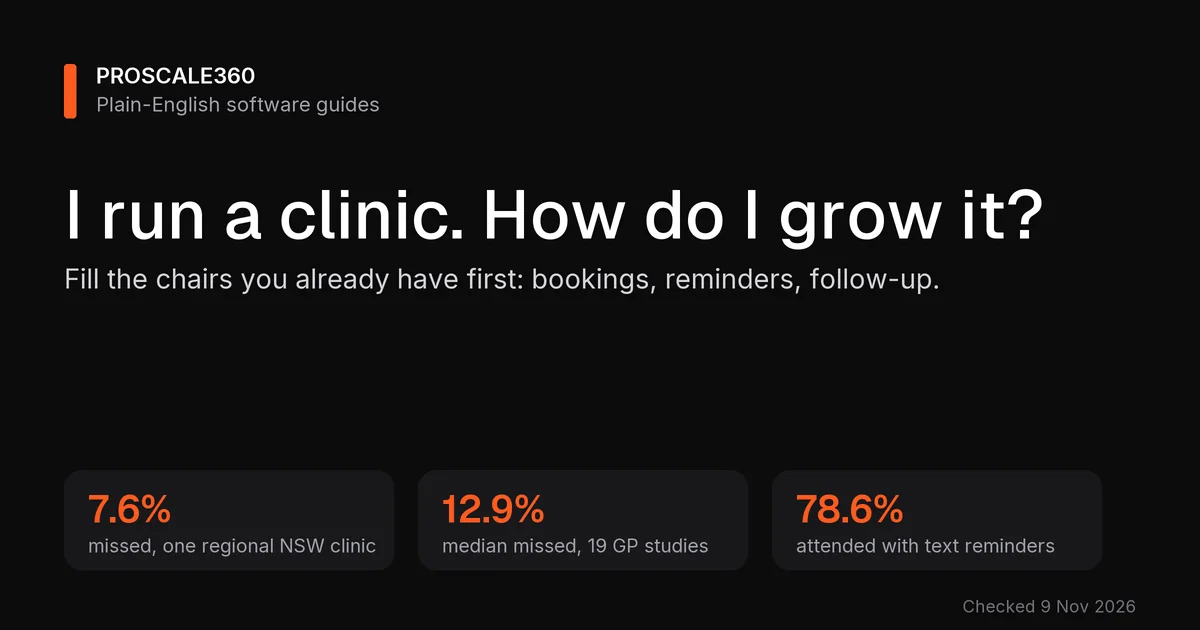
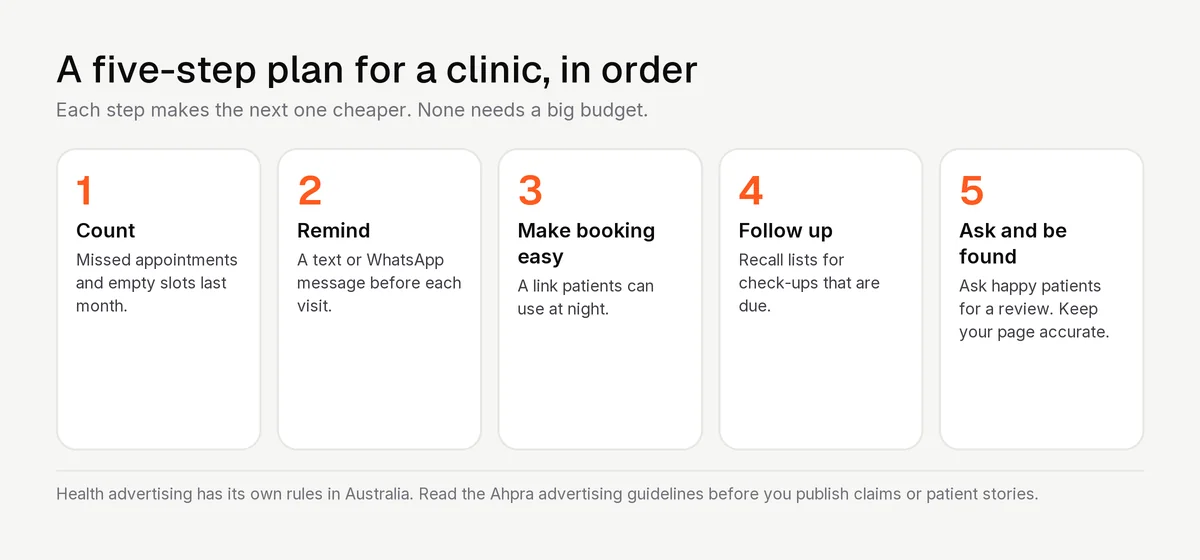
The short answer. Most clinics grow faster by filling the appointments they already have than by buying more advertising. Count the missed visits, send a reminder before every appointment, make booking easy at any hour, and contact patients whose check-up is due. Then ask happy patients for a review. Most of this is routine messaging and record keeping, which software does well. Diagnosis and clinical records stay with your practitioners and your clinical software.
Who this is for. The owner of a GP, physio, dental, psychology, allied health or similar clinic, in Australia or elsewhere, who asks "how do I get more patients?" and has not yet counted how many they lose.
Sourced means we read the original. Our arithmetic is our own sum. Our estimate is our judgement. Dollar amounts are US dollars unless marked A$. We promise no growth figure, because we have none for any clinic.
What clinic owners really search for
- “How do I grow my clinic?” Usually means: more bookings, fewer gaps, patients who come back.
- “How do I reduce no-shows?” The patient booked and did not arrive. The chair sat empty.
- “Best appointment booking system for a clinic.” Online booking, reminders, and a calendar the front desk can trust.
- “WhatsApp for my clinic.” Patients already use it. The rules for using it for appointments are in our WhatsApp guide.
Step 1: count what you are losing
Before you spend on anything, count last month's missed appointments and empty slots. Published rates give you a sense of the range, not your answer.
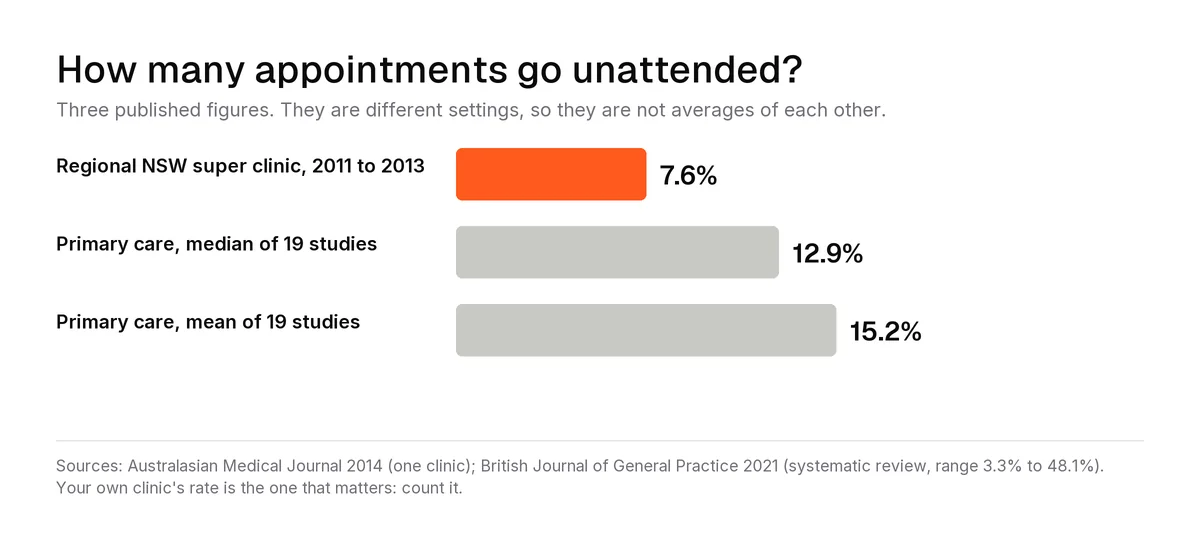
One Australian study of a regional New South Wales general practice super clinic, covering appointments from October 2011 to October 2013, found that 7.6% were missed. Sourced A 2021 systematic review in the British Journal of General Practice found a median of 12.9% and a mean of 15.2% across the 19 studies that reported a rate, with a range from 3.3% to 48.1%. Sourced
The limits. The first is one clinic from a decade ago. The second is mostly studies from outside Australia. Rates vary widely by patient group, service and booking style. Your own number is the one that matters, and your booking system should be able to give it to you.
What it can cost. Imagine 100 appointments a week at a fee of $80, with the lower figure of 7.6% missed. That is 7.6 appointments, or about $608 of income a week. Our arithmetic The fee and volume are imagined; put in your own.
Step 2: remind every patient before the visit
A Cochrane review (2013 update) pooled seven trials with 5,841 people. Attendance was 78.6% with a text message reminder against 67.8% with none, a risk ratio of 1.14 (95% range 1.03 to 1.26). Text reminders worked about as well as phone calls (risk ratio 0.99), at roughly 55% to 65% less cost per attended appointment in two studies. Sourced
The limits. We read the review's published summary, not the full paper. The authors rated the evidence as low to moderate quality, said it was not yet enough to firmly guide policy, and no trial measured health outcomes. The trials used text messages, not WhatsApp, though a WhatsApp reminder is the same idea. The jump from 67.8% to 78.6% came from those trials, so do not expect the same in your clinic. Measure it.
A good reminder says who it is from, the day and time, the practitioner, how to reschedule in one tap, and what to bring. It carries no clinical detail. Messages travel through phone networks and apps, and a lock screen is visible to anyone nearby.
Step 3: make booking easy at 9 pm
Many people think about booking in the evening, when the front desk is closed. An online booking link that shows real free slots, lets patients choose the practitioner and service, and lets them reschedule themselves does three things: it captures the booking while the person is ready, it takes calls off your front desk, and it gives you a record of how people book. Put the link on your website, your Google Business Profile and your messages.
Step 4: follow up, so patients come back
Every clinic has patients who are due for a check-up, a review or a repeat visit and have not booked. A recall list (a list of patients whose follow-up is due) is the simplest growth tool a clinic has, because these people already trust you. A weekly routine is enough: pull the list, send a short message to those who agreed to receive reminders, book those who reply. Do not send anything to people who have not agreed.
Step 5: ask for reviews, and keep your page accurate
People choose a clinic by looking at its page and reviews. Keep your opening hours, services and booking link correct, and ask patients who had a good visit to leave a review, with a link in a polite message after the appointment. Health advertising has its own rules in Australia. The regulator, Ahpra, publishes advertising guidelines, including how testimonials can be used. Read them before you copy reviews onto your own website or social posts, and get your own advice. We are not your adviser on this.
What your patients' information needs from you
The Australian privacy regulator, the OAIC, says information collected while providing a health service is health information, which is sensitive information under the Privacy Act and carries stricter rules. Its guide covers doctors, allied health professionals, private hospitals, pharmacists, telehealth services, gyms and weight-loss clinics, among others. Sourced Version 2.0, May 2025.
In practice: limit who can see what, keep clinical detail out of reminder messages and public AI tools, and know where your data is stored and how you get it out if you change provider. This is general information, not legal advice. Our clinics page has the regulator links.
What software you need, and what it should not replace
Steps 2 to 5 need one thing: a shared customer record connected to a calendar and a messaging channel. That is a small CRM (customer relationship management: a record of every patient or customer and what you last did with them) and an appointment system, with WhatsApp or text attached.
What it should not replace is your clinical software, your clinical notes and your billing to Medicare or insurers. We are not a clinical software vendor and do not claim to be. We build the booking, reminder, recall and marketing side around it.
Our estimate The $599 bundle, paid once. A personalised first build for a small business with one location, from a planning meeting to going live: customer records, online booking with reminders, WhatsApp and social media connected, invoices and simple stock, marketing tools for people who agreed to hear from you, simple reports and data protection built in. Prices are in US dollars. WhatsApp and Meta message fees and hosting are paid by you at cost; we do the integration and set-up. Payroll, accounting ledgers, clinical records, many locations and links to other systems are quoted separately, and the written plan lists what is in and out before you pay. Read what the $599 covers.
How Proscale360 is changing this
Proscale360 is a founder-led, remote-first studio: Alif Vasaya, a marketer in Sydney, and Sabina Ansari, a senior full-stack engineer and tech lead in Ahmedabad.
We want to be the go-to contact for any IT work, priced as clearly as a supermarket shelf. We take the risks. You get the result.
Founder account Between them, our founders have built integrated systems from scratch to live, including project management, ServiceNow, AI integration, and data collection and analysis, and Sabina has eight years of experience leading software projects. That is our own statement and is not independently verified. What we can show you is counted: see the ProteinPlus and Juhapura Mart case studies.
For a clinic we do it the way we do everything: we write a free plan, give one itemised quote, and let you try one piece first, such as reminders and recall. Give us one task and review the working result. If you are happy, you pay. If you are not, you pay nothing. If you like it and want it better, you pay for our effort plus $10 for a round of tweaks and one meeting. The pilot page has the terms. Book a free call or start with the free project plan.
The evidence against us, and who we are not for
We are new and founder-led. There are two of us, so capacity has a ceiling, and we have two published case studies, ProteinPlus and Juhapura Mart. We are not the right choice if you need someone in your office five days a week, a 24-hour support team, or a large programme with many specialists at once.
We have not built a clinic system for a published case, and we cannot show you clinic results. If you need a certified clinical records system, or a vendor with Medicare billing built in, buy established practice software and keep us for the pieces around it.
Frequently asked questions
How do I grow my clinic?
Start by filling the appointments you already have. Count your missed visits, send a reminder before every appointment, make online booking easy, contact patients whose follow-up is due, and ask happy patients for a review. Spend on advertising after that.
How many appointments do patients miss?
It varies a lot. One regional NSW clinic study found 7.6%. A 2021 review of general practice studies found a median of 12.9% and a mean of 15.2%, with a range from 3.3% to 48.1%. Count your own.
Do appointment reminders work?
In a 2013 Cochrane review of seven trials, attendance was 78.6% with text reminders and 67.8% without. The evidence was low to moderate quality and no trial measured health outcomes. Your result will differ, so measure it.
Can I use WhatsApp to remind patients?
Yes, if the patient has agreed to receive messages from you, you say who you are, you make stopping easy, and you keep clinical detail out of the message. Our WhatsApp guide explains the rules.
What does a clinic booking and reminder system cost?
Our published bundle is $599 (US dollars) for a defined first build for one location: customer records, online booking with reminders, WhatsApp connected, invoices, marketing tools and reports. That scope is our estimate until your written plan confirms it. Clinical records and Medicare billing are not included.
Does this replace my practice management software?
No. Keep your clinical software for notes, records and Medicare or insurer billing. A booking, reminder and recall system sits around it.
Sources
- Which patients miss appointments with general practice and the reasons why: a systematic review (BJGP 2021), mean 15.2%, median 12.9%, range 3.3% to 48.1%; read 9 November 2026
- Factors associated with non-attendance in a general practice super clinic population in regional Australia (Australasian Medical Journal 2014), 7.6% missed; read 9 November 2026
- Cochrane: Mobile phone messaging reminders for attendance at healthcare appointments, 2013 update; we read the published summary, not the full paper
- OAIC: Guide to health privacy, key concepts, version 2.0, May 2025; read 9 November 2026
- Ahpra: Guidelines for advertising a regulated health service, read for the clinics page on 4 November 2026
- Proscale360 price list, our own published prices, US dollars
General information, not medical, legal or financial advice. We found no source for how much a clinic grows from any one step, so we give none. Prepared by the Proscale360 team with AI assistance. Checked 9 November 2026.
We specialise in exactly this kind of project. Get a free consultation and a fixed quote.