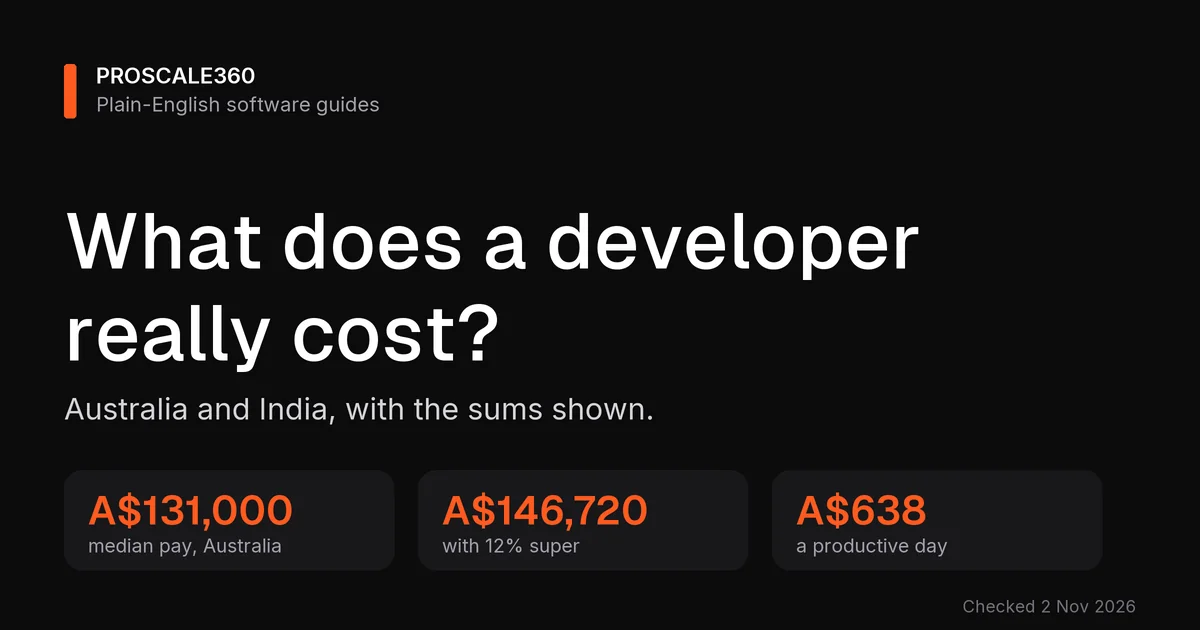
The short answer. One Australian developer on the median pay of A$131,000 costs about A$146,720 a year once the 12% super is added. Spread over the days they actually work, that is about A$638 a day, before recruiting, equipment, insurance and management. A developer in India is paid an average of ₹730,000 a year, about A$10,961.
The catch. Those are what employees are paid. They are not what a studio charges, and dividing one by the other does not tell you what you would save. This article shows the sums, where each number came from, when hiring beats outsourcing, and how to check any quote.
Who it is for: an Australian owner choosing between hiring a developer, using a freelancer, or paying a studio. Sourced means we read the original. Our arithmetic means we calculated it from sourced inputs. Price list means our own published prices.
The numbers at a glance
| Number | What it is | Type | Where it comes from |
|---|---|---|---|
| A$131,000 | Median base pay, Australian software developer | Sourced | Employment Hero salary guide, October 2026 |
| A$109,500 | Average base pay, same job, self-reported | Sourced | Glassdoor Australia, 5,113 salaries, November 2026 |
| 12% | Super an employer adds on top of pay | Sourced | Australian Taxation Office, 2025-26 and 2026-27 |
| A$146,720 | Median pay plus super, per year | Our arithmetic | A$131,000 + A$15,720 |
| A$638 | Cost per day actually worked | Our arithmetic | A$146,720 ÷ 230 days |
| ₹730,000 | Average pay in India, about A$10,961 | Sourced | Glassdoor India, 82,057 salaries, November 2026 |
What an Australian developer costs
Two widely used sources disagree, and the gap is worth understanding before you pick a number.
Employment Hero, the HR and payroll company, reports a median base salary of A$131,000 for a software developer in Australia. Its typical range runs from A$104,000 (the lower quarter) to A$158,000 (the upper quarter), and it quotes A$78,000 for a junior and A$120,000 for a mid-level developer. These are its own payroll data, last updated October 2026, and they cover base pay only, with no bonuses or super.
Glassdoor Australia shows a lower average of A$109,500, with a range from A$81,375 to A$132,263, from 5,113 salaries that employees submitted anonymously. Self-reported data mixes job titles and experience, and we cannot see how it was checked.
We do not know why the two differ, and we will not guess. One more warning sign: Employment Hero's own city table lists Sydney at A$107,000, below its national median of A$131,000, which tells you how rough any single figure is. So treat the honest answer as a range of roughly A$109,500 to A$131,000 in base pay, and use the median for the sums below because it comes from payroll records rather than self-reports.
The costs on top of the salary
- Super. The Australian Taxation Office lists the super guarantee at 12% for 1 July 2025 to 30 June 2026, and the same 12% for 2026-27 and from 1 July 2027 onwards. From 1 July 2026, employers pay it on each payday instead of quarterly. Sourced
- Paid time off. The Fair Work Ombudsman says full-time and part-time employees get 4 weeks of annual leave, and full-time employees get 10 sick days a year, which carry over if unused. You pay for those days and get no work on them. Sourced
- Payroll tax. In NSW it is 5.45% of wages, but only on the part above $1,200,000 a year (Revenue NSW, unchanged from 2025-26 to 2026-27). A business whose total yearly wage bill is under that pays none. Other states have their own thresholds, which we did not check. Sourced
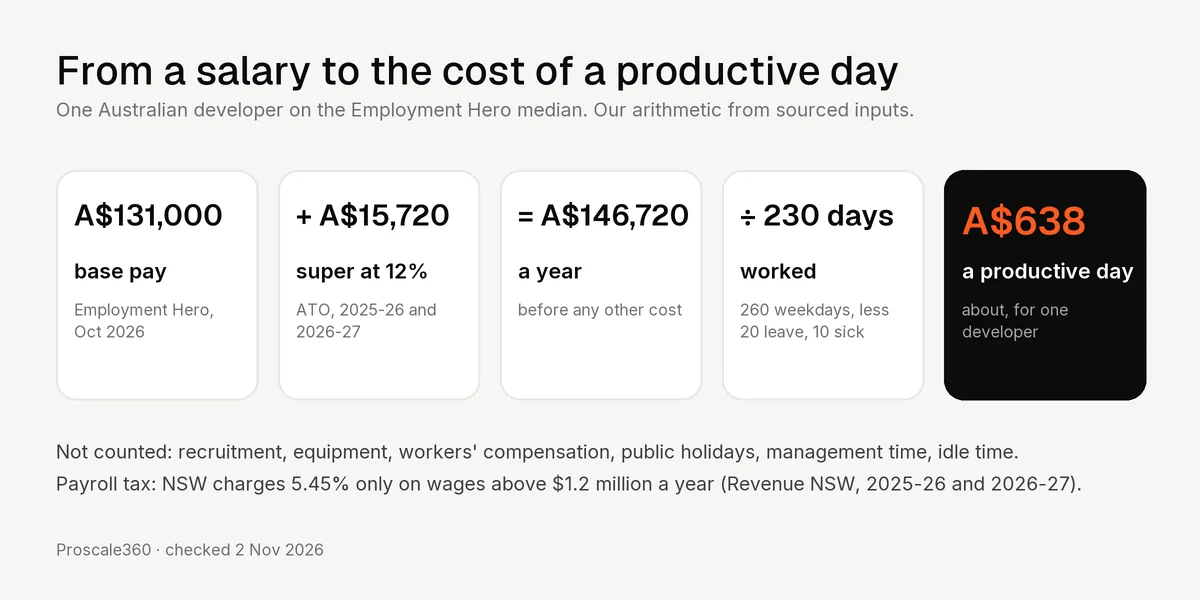
Here is the arithmetic in plain words. Start with A$131,000. Add 12% super (A$15,720) and you reach A$146,720. A year has 260 weekdays. Take out 20 days of annual leave and 10 sick days and 230 days are left. A$146,720 divided by 230 is A$638 for each day the developer actually works. If you used the lower Glassdoor average instead, the same steps give A$122,640 a year and A$533 a day.
We did not remove public holidays, because they differ by state, and we did not remove any time lost to meetings, waiting or gaps between hires. Real cost per productive day is therefore higher.
What is not in that number
- Recruitment, whether you pay an agency or spend your own time. We found no reliable figure, so we show none.
- A laptop, software licences and a desk.
- Workers' compensation insurance, which varies by state.
- Management time. Someone has to decide what the developer works on and check it is good.
- Notice and redundancy if the role ends, which sit in the National Employment Standards.
- The days with no work to give them. This is the big one, and the next sections come back to it.
What a developer in India is paid
Glassdoor India reports an average of ₹730,000 a year for a software developer, with a typical range from ₹425,000 (lower quarter) to ₹1,363,250 (upper quarter), from 82,057 salaries submitted in November 2026. At the Reserve Bank of Australia's rate on 2 November 2026 (A$1 = 66.6 rupees) that is about A$10,961, with a range of A$6,381 to A$20,469.
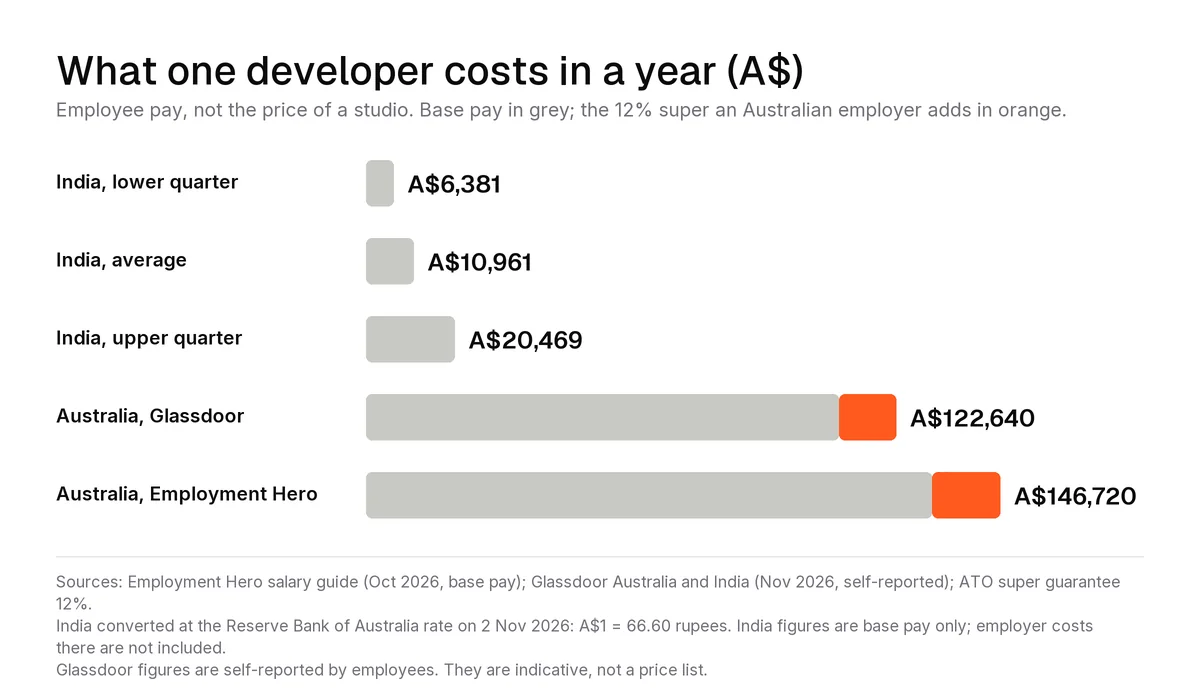
Three limits matter. First, this is self-reported data, and the same page shows entries such as ₹45 to ₹52 lakh and ₹1 to ₹2 crore for developers with four to six years of experience. We treat those as errors or extreme cases, which is why we quote the quarters and the average instead of the highest figure. Second, the large services firms on the page (TCS, Infosys, Cognizant, Accenture) show median developer pay of about ₹5 to ₹6 lakh, so the figure moves a lot with the employer. Third, these are base pay figures. We have not priced employer costs in India, so the bars for India are not directly comparable with the Australian bars that include super.
Why the gap is not what you would save
It is tempting to divide A$146,720 by A$10,961 and announce that outsourcing is more than ten times cheaper. Please do not. Three reasons:
- Pay is not price. A studio's price covers the developer's salary and also design, testing, someone managing the job, tools, hosting, the time between projects, and the risk of getting it wrong. It is also a price for a result, not for a person's year.
- The comparison is between different things. Hiring buys capacity: a person's time. A studio sells an outcome at a stated price. The cheapest option depends on how many days of real work you have.
- A low quote can hide a high bill. Vague scope, extras charged later and a slow handover all turn a cheap quote into an expensive project.
Three ways to pay for software
| Hire an employee | Freelancer or contractor | Studio, fixed price | |
|---|---|---|---|
| You pay for | A person's time, all year | Hours, or a fixed fee for one job | A defined result at a stated price |
| You manage | Everything, including what they work on | Scope, and checking the quality | Decisions. The studio manages the work |
| Main risk | Paying for idle days; one person leaving | One person's availability and skill, which you must judge | Unclear scope growing; poor visibility; time-zone gaps |
| Best when | Steady daily work for a year or more, or software is your product | A clear, smaller job and you can judge the result | A one-off build, or no one in-house to lead the tech |
When hiring in Australia is the right call
We build software for a living, and we will still tell you this: if you have steady work for a developer most days of the year, hire one. You get someone in your time zone who learns your business, and the A$638 a day is fair value when every day is used.
The trouble is the unused days. The salary is fixed. If you only had 40 days of real development work in a year, each of those days would cost A$3,668 (A$146,720 ÷ 40). Our arithmetic That is the situation where most small businesses are: a website, a booking system, an invoice tool, then months of little change.
Hire when you would keep them busy, when software is the heart of what you sell, when you need someone in the room, or when your own rules require work to stay onshore. Check your obligations with a qualified adviser. We are not one.
What goes wrong when you outsource, and how to check
Outsourcing to India works for many businesses and fails for some. The failures follow a pattern, and every one can be checked before you pay.
- Time zones. Our hours are Monday to Saturday, 10 AM to 7 PM India time. In November that gives Sydney about an hour and a half of overlap each day, more once daylight saving ends in April, and Perth about four and a half hours. Plan for clear written updates, not constant calls. The Australia page has the overlap for each city.
- Vague quotes. "Fixed price" can hide exclusions. Ask for every line.
- No visibility. You should be able to see working progress and know who is writing the code.
- Paying before you have seen anything. Ask to see a working result first.
- Who owns the code. Get it in writing that you own the custom code once you have paid.
Seven checks for any quote, from anyone
- Is every line itemised, with what is inside it?
- Who will write it, and can you see their names?
- Can you review a working result before you pay in full?
- Do you own the custom code once paid, in writing?
- Are third-party costs (domain, hosting, paid tools) listed separately and paid to the provider directly?
- Are the payment steps stated before work starts?
- Is there a real example you can look at, with numbers that were counted rather than claimed?
We turned these into a one-page PDF, questions to ask a software vendor, and our outsourcing FAQ goes deeper on risk, cost and ownership. If you already hold a quote, send it to us: we price the same work next to it, and where yours is lower we will say so.
How Proscale360 is changing this
Proscale360 is a founder-led, remote-first studio: Alif Vasaya, a marketer in Sydney, and Sabina Ansari, a senior full-stack engineer and tech lead in Ahmedabad. We started because quoting software is the part that makes buyers nervous, so we are trying to remove the nervousness.
We want to be the go-to contact for any IT work, priced as clearly as a supermarket shelf. We take the risks. You get the result.
In practice that means four things you can check on this site today.
1. The price is on the shelf
| What | Price (US dollars) | About, in A$ | Includes |
|---|---|---|---|
| Starter website | $145 | A$206 | 5 pages, 1 month of support |
| Business website | $340 | A$484 | 12 pages, 3 months of support |
| Online store | $580 | A$826 | Business website plus the $240 store add-on |
| Custom software, from | $720 | A$1,025 | 6 months of support |
| Admin panel or invoice system, from | $480 | A$683 | Itemised quote for anything bigger |
| AI integration | $480 simple, $1,200 advanced | A$683 and A$1,709 | Scoped before we start |
Put that next to the sums above. Our Business website, about A$484, costs less than one productive day of the developer in the sums (A$638). That does not mean a day of their time equals our site. It means most small businesses do not need a developer's year, they need one specific thing built well. See the website cost guide and the custom software cost guide for what drives each price.
2. You try before you decide
Give us one task and review the working result yourself. If you are happy, you pay. If you are not, you pay nothing: tell us what missed and we scrap that work. If you like it and want it better, you pay for our effort plus $10 for a round of tweaks and one meeting. The pilot page has the full terms. We take the risk of the first attempt because we think a buyer should see the work before paying for it.
3. Small changes stay small
After launch, a small change, meaning something that takes us about an hour of work or less, is about $10. Anything bigger is quoted first and you approve it. Our support and upgrades page explains what that covers.
4. AI does the routine work, and people check it
For a new, clearly defined build, AI tools write much of the routine code and a person reviews it. That is why a good business website is, in our founders' own experience, about two days of work and a full store about a week, once your plan is agreed and your content is ready. That is experience, not a guarantee, and custom software takes months. The research on AI and speed is mixed for large, old codebases, and we have read it and summarised it on our page about AI coding productivity studies and in why software costs are changing.
The evidence against us, and who we are not for
We are new and founder-led. There are two of us, so our capacity has a ceiling, and we have two published case studies, ProteinPlus and Juhapura Mart, with what is inside each one counted from its own code rather than claimed. That is not a long track record, and you should weigh it.
We are not the right choice if you need someone in your office five days a week, a 24-hour support team, or a large programme with many specialists at once. In those cases hire, or choose a larger firm, using the seven checks above.
How to decide in ten minutes
- Count the real days. How many days of development work will you actually have in the next 12 months? If it is close to 230, hire.
- If it is fewer, check the scope. Can you say clearly what you want built? If yes, get an itemised fixed-price quote, or start with a pilot.
- If the scope is unclear, write it down first. Our free project plan does that, and you can book a free call to talk it through.
- Whoever you choose, run the seven checks.
If you want to see the price of your idea next to the sums in this article, send us your quote or your idea. For a quick read of how the cost of a website is built up, see our older guide how much for website creation.
Frequently asked questions
How much does a software developer earn in Australia?
Employment Hero reports a median base salary of A$131,000 (October 2026), with a typical range of A$104,000 to A$158,000. Glassdoor Australia shows a lower average of A$109,500 from 5,113 self-reported salaries. Both are base pay, before super.
What does an Australian developer really cost an employer?
At the median of A$131,000, adding 12% super gives A$146,720 a year. After removing 20 days of annual leave and 10 sick days, that is about A$638 for each day worked, before recruitment, equipment, insurance, management and public holidays. This is our arithmetic from the ATO and Fair Work figures.
How much is a software developer paid in India?
Glassdoor India reports an average of ₹730,000 a year (about A$10,961 at the RBA rate on 2 November 2026), with a typical range of ₹425,000 to ₹1,363,250. It is self-reported data and varies a lot by employer.
Is outsourcing to India really cheaper than hiring in Australia?
Pay is far lower, but pay is not the price you are charged. A studio's price includes design, testing, management and risk, and it buys a result rather than a person's year. Compare itemised quotes line by line, and see the working result before you pay in full.
When should I hire a developer instead of using a studio?
Hire when you have steady development work for most days of the year, when software is central to your product, or when you need someone in your office. If you have only a few weeks of real work a year, a fixed-price build or a pilot usually costs less.
What does Proscale360 charge, and can I try it first?
Our published start prices are $145 for a 5-page website, $340 for a 12-page business website, $580 for an online store and from $720 for custom software, in US dollars. You can give us one task first: if you are happy you pay, and if you are not you pay nothing.
Sources
- Employment Hero, Software Developer salary guide Australia 2026, own payroll data, last updated October 2026; accessed 2 November 2026
- Glassdoor Australia, Software Engineer Developer salaries, self-reported; accessed 2 November 2026
- Glassdoor India, Software Developer salaries, self-reported; accessed 2 November 2026
- Australian Taxation Office, Super guarantee, last updated 17 April 2026; accessed 2 November 2026
- Fair Work Ombudsman, Annual leave, accessed 2 November 2026
- Fair Work Ombudsman, Sick and carer's leave, accessed 2 November 2026
- Revenue NSW, Payroll tax thresholds and rates, last updated 1 July 2026; accessed 2 November 2026
- Reserve Bank of Australia, Exchange rates, rates for 2 November 2026
- Proscale360 price list, our own published prices
General information, not financial, tax or legal advice. Check your own obligations with a qualified adviser. Prepared by the Proscale360 team with AI assistance. Every figure was checked against the sources above on 2 November 2026. Salary data, tax rates and exchange rates change, so check again before you rely on them.
We specialise in exactly this kind of project. Get a free consultation and a fixed quote.