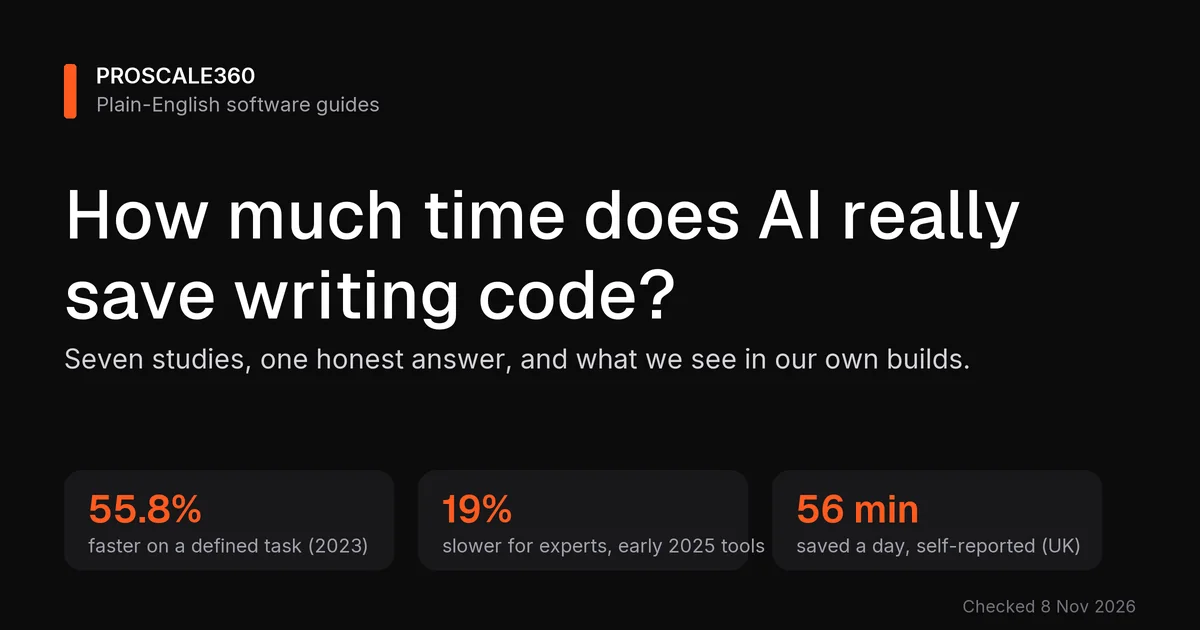
The short answer. It depends on the task, the tools and the person, and the studies show it. A clearly defined new task was done 55.8% faster in a 2023 experiment. Google's randomised trial found about 21% less time on a complex task. A UK government trial found people said they saved 56 minutes a working day, about 13% of a 37-hour week. But METR's 2025 study found experienced developers working in large, mature codebases took 19% longer with the early-2025 tools they had.
What that means. For a new, well-defined build, AI can save a lot. For old, large, complex systems and experts, the gain is smaller and less certain. Our founders see much bigger savings on new full builds, and we tell you where that is our own estimate.
Sourced means we read the original paper or report. Our arithmetic means we calculated it. Our estimate means our own judgement.
The seven studies, plainly
| Study | What was tested | Result | The limit |
|---|---|---|---|
| Peng et al., GitHub and Microsoft Research, Feb 2023 | Developers built an HTTP server in JavaScript as fast as possible, with or without GitHub Copilot | The group with the assistant finished 55.8% faster | One defined, self-contained task set up for the test |
| Paradis et al., Google, Oct 2024 | 96 full-time Google engineers on a complex, enterprise-grade task, with three AI features | Best estimate about 21% less time, with a large confidence interval | Authors say it may not carry over to other tools or time |
| Cui et al., Management Science, published 27 Feb 2026 | Three randomised experiments at Microsoft, Accenture and a Fortune 100 company, 4,867 developers | 26.08% more completed tasks among users | Noisy; counts tasks, not quality or hours |
| Chatterjee et al., ANZ Bank, Feb 2024 | Six-week trial with Copilot and control groups, then about 1,000 engineers | A notable boost in productivity and code quality; inconclusive on security. No single percentage given | Run by the bank's own team; small and short |
| UK Government Digital Service, published 12 Sep 2025 | 2,500 licences, 50+ public bodies, Nov 2024 to Feb 2025; 424 survey responses | Users reported saving 56 minutes a working day; 15.8% of suggested lines accepted | Self-reported; the report warns of overestimation and optimism bias |
| METR, July 2025, updated Feb 2026 | 16 experienced open-source developers, 246 real tasks in large mature repositories | Tasks took 19% longer with early-2025 tools, though developers expected 24% faster | Small; METR now calls the result out of date and its 2026 data unreliable |
| Stack Overflow Developer Survey, 2025 | Annual developer survey | 84% use or plan to use AI tools; 46% distrust accuracy, 33% trust it | Measures use and trust, not speed |
Why the answers differ
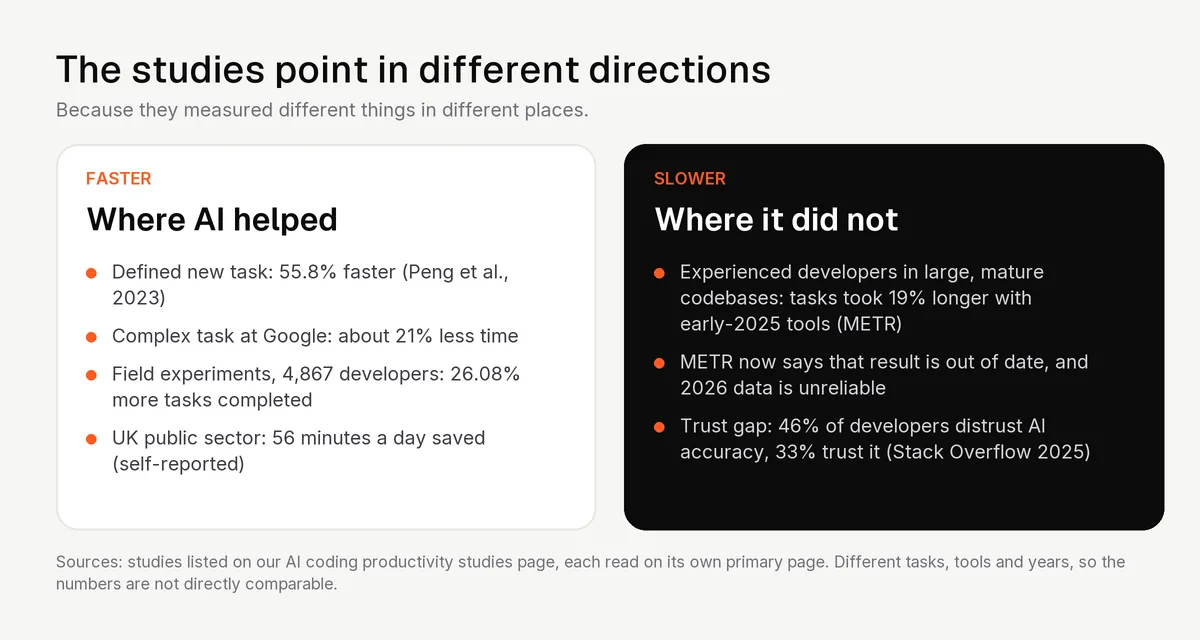
- Task type. A fresh, clearly specified task (Peng) shows large gains. Complex enterprise work (Google) shows moderate ones. Familiar work in a huge old codebase (METR) showed a slowdown.
- Who the people were. METR used experienced contributors to projects they knew well. Cui et al. found less experienced developers adopted the tool more and gained more.
- What was measured. Time on one task, tasks completed, or minutes people said they saved. Self-reports are weaker evidence, and the UK report itself warns about optimism bias. METR found developers expected to be 24% faster and were 19% slower, which is a warning about trusting how fast it feels.
- When. The tools improve quickly. METR now says its early-2025 result is out of date and believes developers are likely more sped up now, but that its newer data is unreliable because many developers refused to work without AI. Sourced
What this means for your project
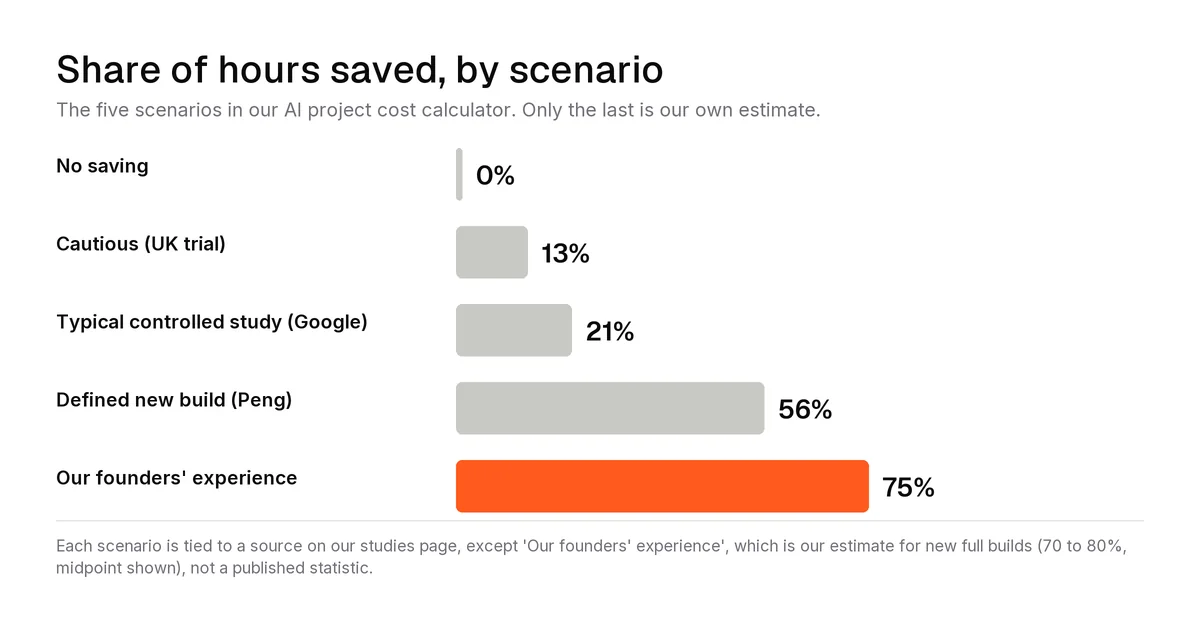
Our AI project cost calculator turns the studies into five scenarios for the share of hours AI saves on a whole job. Only the last is our own estimate.
| Scenario | Hours saved | Basis |
|---|---|---|
| No saving | 0% | Worst case: METR's early-2025 slowdown |
| Cautious | 13% | UK trial: 56 minutes a day is about 13% of a 37-hour week Our arithmetic on a self-reported figure |
| Typical controlled study | 21% | Google randomised trial |
| Defined new build | 56% | Peng et al.: 55.8% faster on a clearly defined task |
| Our founders' experience | 75% | Our estimate for new full builds: 70 to 80%, midpoint shown. Not a published statistic |
Our rule of thumb for buyers: if you are building something new and clearly defined, expect savings between the controlled-study figures (about a fifth) and the defined-task figure (more than half), and push your builder to explain which applies. If you are changing a large, old, complex system, assume the gain is small, and be wary of anyone who promises more.
Where AI still needs people
None of these studies shows that AI replaces the people who check. Stack Overflow's 2025 survey found more developers distrust the accuracy of AI tools (46%) than trust them (33%). The UK trial found 15.8% of suggested lines were accepted, so most suggestions were not used. That fits how we work: AI does the routine typing, and people do the checking.
How Proscale360 is changing this
Proscale360 is a founder-led, remote-first studio: Alif Vasaya, a marketer in Sydney, and Sabina Ansari, a senior full-stack engineer and tech lead in Ahmedabad.
We want to be the go-to contact for any IT work, priced as clearly as a supermarket shelf. We take the risks. You get the result.
Our founders' own experience is that a business website can take about two days and an online store about a week for a new, clearly defined build, once the plan is agreed and your content is ready. Custom software takes months. That is experience, not a guarantee, and every timeline in your plan states its conditions. Our estimate
The evidence we can show is counted rather than claimed: ProteinPlus, built by Alif Vasaya with AI tools and without a developer, by his own account, has 44 commits in its first 3 days, 65 page files and 31,225 lines of code, counted from its own git history. Counted Commit counts are not hours, and one experienced builder is not a typical beginner. Read the ProteinPlus case study and the full AI coding productivity studies page, and see why software costs are changing.
Give us one task and review the working result. If you are happy, you pay. If you are not, you pay nothing. If you like it and want it better, you pay for our effort plus $10 for a round of tweaks and one meeting. The pilot page has the terms. Founder account Between them, our founders have built integrated systems from scratch to live, including project management, ServiceNow, AI integration, and data collection and analysis, and Sabina has eight years of experience leading software projects. That is our own statement and is not independently verified. What we can show you is counted: see the ProteinPlus and Juhapura Mart case studies.
The evidence against us, and who we are not for
We are new and founder-led. There are two of us, so capacity has a ceiling, and we have two published case studies, ProteinPlus and Juhapura Mart. We are not the right choice if you need someone in your office five days a week, a 24-hour support team, or a large programme with many specialists at once.
Our 75% figure is our estimate, and the controlled studies suggest you should plan with a lower one for anything large or old. Ask any builder, including us, to show their basis.
Frequently asked questions
How much faster is coding with AI?
It depends. A 2023 experiment found a defined task finished 55.8% faster with an AI assistant. Google's randomised trial found about 21% less time on a complex task. A field experiment of 4,867 developers found 26.08% more completed tasks. METR found experienced developers in large old codebases took 19% longer with early-2025 tools.
Does AI make experienced developers slower?
In METR's 2025 study, 16 experienced open-source developers took 19% longer on tasks in large, mature repositories with early-2025 tools, though they expected to be 24% faster. METR now says that result is out of date and its newer data is unreliable.
How reliable are self-reported time savings?
Less reliable than measured ones. The UK government trial reported an average saving of 56 minutes a working day, but its own report warns of possible overestimation and optimism bias.
How long does it take to build a website with AI?
Our founders' experience is about two days for a business website and about a week for an online store, for a new, clearly defined build once the plan is agreed and content is ready. It is experience, not a guarantee, and custom software takes months.
Can AI replace developers?
The studies do not show that. They show time savings on tasks, with people still reviewing the work. Stack Overflow's 2025 survey found 46% of developers distrust AI accuracy, and the UK trial found 15.8% of suggested lines were accepted.
How can I estimate AI savings for my project?
Use our AI project cost calculator, which offers five scenarios from no saving to our founders' estimate, each tied to a source. Treat savings as smaller for large, old, complex systems.
Sources
- Peng et al., The Impact of AI on Developer Productivity (GitHub Copilot), February 2023
- Paradis et al., How much does AI impact development speed? (Google), October 2024
- Cui et al., Management Science, randomised field experiments on AI coding assistants, published 27 February 2026
- Chatterjee et al., ANZ Bank Copilot trial, February 2024
- UK Government Digital Service, AI coding assistant trial: public sector findings, published 12 September 2025
- METR, Uplift update, updated February 2026
- Stack Overflow, 2025 Developer Survey, 2025
General information. Each study was read on its own primary page on 1 November 2026 for our studies page. Results are not directly comparable. Prepared by the Proscale360 team with AI assistance.
We specialise in exactly this kind of project. Get a free consultation and a fixed quote.