The short answer. Before you compare prices, check that you are holding the same kind of document. A quote fixes a price and becomes binding once you accept it. An estimate is an educated guess. Then put every quote into the same eight rows (what is included, the total with GST, extras, who does the work, payment steps, changes, support, ownership) and only then compare the totals.
Why it matters. The cheapest-looking quote is often the one that leaves things out. In our invented example below, the quote that looks A$570 cheaper on the front page ends up A$780 dearer over the first year once hosting and support are added.
Who it is for: an Australian owner holding two or three quotes for a website, store, app or software tool. Sourced means we read the original. Our example means we made it up to show the method. Price list means our own published prices.
First: is it a quote or an estimate?
The two words sound alike and mean different things. The Northern Territory Government's consumer guidance puts it plainly: a quote is legally binding if it forms part of a contract, and it becomes a contract when someone offers the work for a fixed price and you accept the offer, conditions included. An estimate is often just an educated guess at the approximate cost, given without knowing the full extent of the work. If you go ahead on an estimate, the guidance warns, you may have to pay the final amount even if it is higher. It also warns that an estimate can look like a detailed quote. Sourced
The federal government's business.gov.au says the same from the seller's side: once a customer accepts a quote it becomes a legally binding contract. Sourced The NT guidance adds a protection worth knowing: you should not be charged for extra work you did not approve, and it suggests asking for a written quote once the facts are known. These are consumer guides from government websites. They are not legal advice, and the rules for a business buying from a business can differ, so check your own position with a qualified adviser.
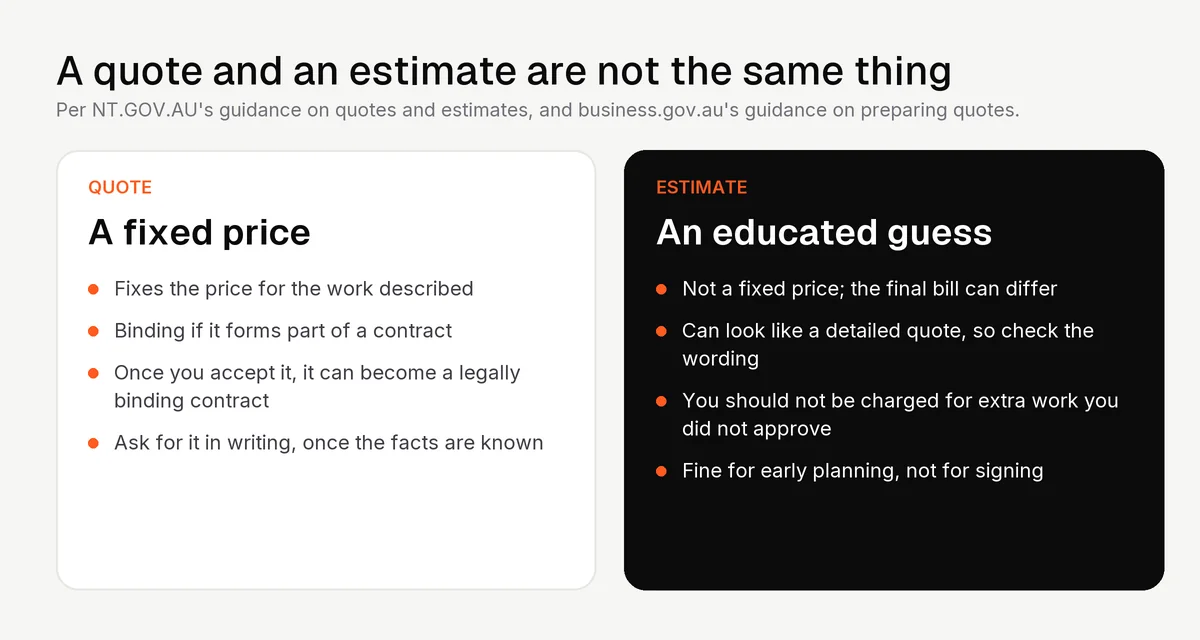
What to do with that: if a document says “estimate”, “approximately” or “from”, treat it as a conversation, not a price. Ask the person to turn it into a written quote once you both agree what is being built.
What a good written quote contains
business.gov.au lists what a good written quote includes: the seller's business name and ABN, your details, a clear description of the work, itemised costs and the total cost with GST, any variations discussed, payment terms, start and finish dates, when the quote expires, and a place for you to sign and date your acceptance. Sourced
Use that as a checklist against every document you receive. If something is missing, ask for it before you accept. Accepting is the moment the quote turns into a contract, so the time to ask is before, not after.
The eight rows to compare
Copy this grid onto a page and fill in one column per quote. If you cannot fill in a cell, that is your first question to the seller.
| Row | What to write down | Warning sign |
|---|---|---|
| 1. Scope | The pages, features and systems that are included, in the seller's own words | A one-line description; “full website” with no page count |
| 2. Total with GST | One total, including GST, that you could be asked to pay | A price with no GST statement; a “from” price |
| 3. Extras | Hosting, domain, paid plugins, stock images, email, anything paid to a third party | “Not included” with no figure; fees paid through the seller with a markup |
| 4. Who does the work | Names or roles of the people building it, and where they are | No names; work passed on without telling you |
| 5. Payment steps | How much, when, and what you will have seen by then | Most of the money due before you see anything working |
| 6. Changes | How a change is requested, priced and approved | “Variations at our rates” with no rate |
| 7. Support | How many months are included, what they cover, what a small fix costs afterwards | “Support available” with no months or price |
| 8. Ownership and exit | Who owns the code and the content once paid; what you get if you leave | Silence on ownership; handover only on request |
Rows 3, 6 and 7 are where most of the difference between two quotes hides, because they are the rows sellers leave short when they want the headline to look small.
A worked example, on the same basis
These numbers are invented, to show the method. Our example Suppose you have two quotes for the same small business website.
- Quote A is A$2,400 including GST for the build. Hosting is not included and costs A$600 a year. It includes one month of support; more is A$150 a month.
- Quote B is A$2,970 including GST. It includes the hosting and six months of support.
Quote A looks about A$570 cheaper (A$2,400 against A$2,970). But to match Quote B's six months of support, you would need five more months at A$150, which is A$750. Add the A$600 for hosting and Quote A's first year comes to A$3,750, against A$2,970 for Quote B: a difference of A$780.
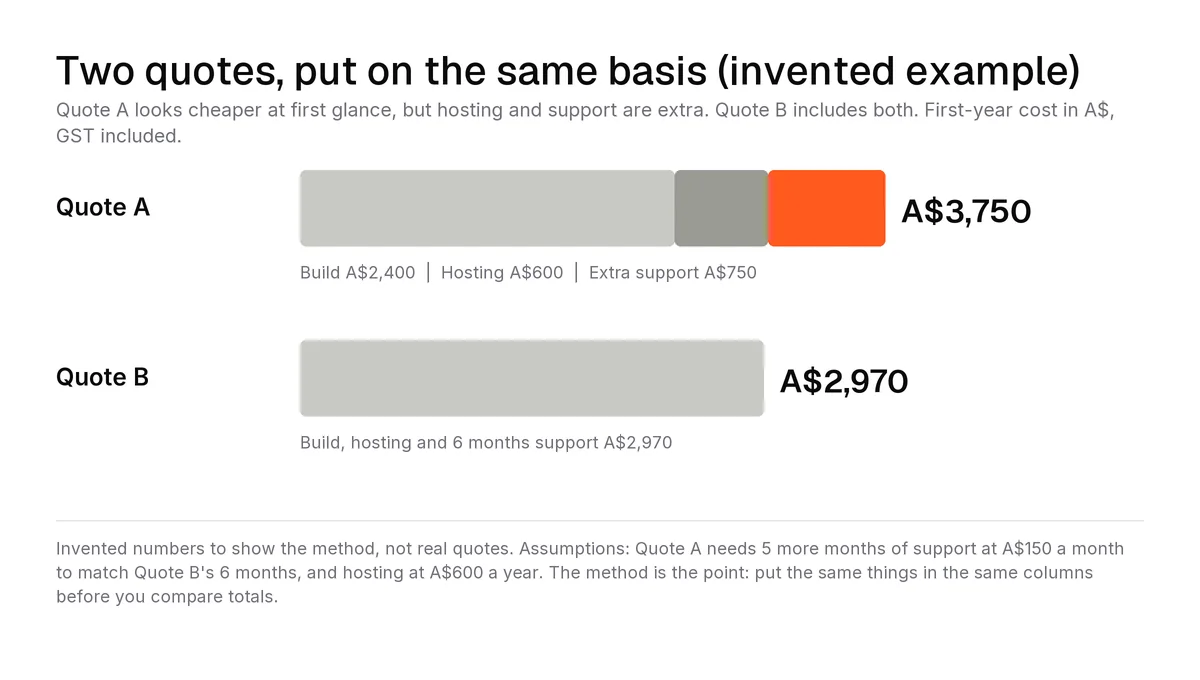
The point is not that the bigger number is wrong. Quote A might come from a seller you trust more, and that can be worth paying for. The point is that you can only decide once both are in the same rows.
Six traps, and the question that defuses each
- “From” prices. A starting price is not a total. Ask: “What is the price for exactly what I described, including GST?”
- Vague scope words. “Basic”, “standard” and “full” mean different things to different sellers. Ask for counts: pages, forms, user types, integrations.
- Costs paid to someone else. Domains, hosting and paid tools should be listed with their price and ideally paid by you directly to the provider. Ask: “Which of these would I pay directly, and which do you charge me for?”
- Payment up front. Ask: “What will I have seen working by the time each payment is due?”
- Open-ended changes. Ask: “How do you price a change after we agree the scope, and do I approve it before you start?” The NT guidance says you should not be charged for extra work you did not approve, so get the approval step in writing.
- Silence on ownership and exit. Ask: “Once I have paid, who owns the code, and what do I receive if I leave?”
Check the claims, and check the contract terms
The Australian Competition and Consumer Commission (ACCC) says claims a business makes should be true, accurate and based on reasonable grounds, and that a business must be able to prove any claim it advertises. The page lists quotes, testimonials and websites among the places this applies, and says intention does not matter. Sourced So if a quote says “fastest”, “guaranteed” or “best”, it is fair to ask what that is based on. A seller who can answer calmly is a good sign. One who cannot is telling you something too.
If the quote comes with a standard contract, the ACCC's contracts page explains that, from 9 November 2023, unfair terms in standard form contracts are banned for small business, which it describes as fewer than 100 employees or turnover under $10 million, and a term found unfair is void. It gives examples such as terms that let only one side end the contract, change its terms or avoid its responsibilities, or penalise only one side for early termination. Sourced That is a reason to read the cancellation, change and penalty clauses before you sign, not a guarantee that a bad clause can be undone.
How Proscale360 is changing this
Proscale360 is a founder-led, remote-first studio: Alif Vasaya, a marketer in Sydney, and Sabina Ansari, a senior full-stack engineer and tech lead in Ahmedabad. Quoting software is the part buyers dread, so we have tried to make ours easy to compare.
We want to be the go-to contact for any IT work, priced as clearly as a supermarket shelf. We take the risks. You get the result.
1. Our prices are published
Price list In US dollars: a 5-page Starter website is $145 (about A$206), a 12-page Business website is $340 (about A$484), an online store is $580 (about A$826), and custom software starts from $720. Hosting and a domain are about $40 to $80 a year, passed on at cost. Australian dollar figures use the Reserve Bank of Australia rate of 2 November 2026 (A$1 = US$0.7023); your quote states the figure you will actually pay. The pricing page shows what each includes, and nothing hidden explains our rules on extras.
2. Send us the quote you already hold
Send the quote or idea you have through get a quote. We price the same work next to it, row by row, and where the other quote is lower we will say so. The compare any quote page explains how.
3. Try one task before you commit
Give us one task and review the working result. If you are happy, you pay. If you are not, you pay nothing. If you like it and want it better, you pay for our effort plus $10 for a round of tweaks and one meeting. The pilot page has the terms.
4. Small changes stay small
After launch, a change that takes about an hour of our time or less is about $10. Anything bigger is quoted and you approve it first. See support and upgrades.
For the sums behind our prices and how the cost of building software is changing, read why software costs are changing.
The evidence against us, and who we are not for
We are new and founder-led. There are two of us, so our capacity has a ceiling, and we have two published case studies, ProteinPlus and Juhapura Mart, with what is inside each counted from its own code. That is not a long track record, and you should weigh it.
We are also not the right choice if you need someone in your office five days a week, a round-the-clock support team, or a large programme with many specialists at once. In those cases, use the eight rows with a larger firm or an in-house hire.
A ten-minute method
- Check each document says “quote” and is written, not “estimate” or “from”.
- Check it has the business.gov.au basics: ABN, itemised costs with GST, payment terms, dates and an expiry.
- Fill in the eight rows, one column per quote.
- Ask the one question for every empty cell, in writing.
- Compare first-year totals, not headline prices. Then weigh trust, which numbers cannot capture.
Not sure what to ask for in the first place? Our free project plan writes the scope down, and you can book a free call to talk it through.
Frequently asked questions
What is the difference between a quote and an estimate?
A quote fixes a price for the work described and, once accepted, can become a legally binding contract. An estimate is an educated guess given before the full extent of the work is known, so the final bill can differ. Sources: NT.GOV.AU and business.gov.au.
What should a written quote include in Australia?
According to business.gov.au: the seller's business name and ABN, your details, a clear description of the work, itemised and total costs including GST, any variations discussed, payment terms, start and finish dates, an expiry date, and a place to sign and date acceptance.
Can I be charged for work I did not approve?
The NT Government's consumer guidance says you cannot be charged for extra work you did not approve. It is general guidance, not legal advice, and your situation may differ, so get approval steps for changes written into the quote.
Why is the cheapest quote often not the cheapest?
Because hosting, support, changes and ownership are often left out of the headline price. Put every quote into the same rows, add the extras, and compare first-year totals, as in the worked example in this article.
Does the ACCC cover quotes from software companies?
The ACCC says claims in advertising, quotes, testimonials and websites should be true, accurate and based on reasonable grounds, and that a business must be able to prove any claim it advertises. It does not resolve individual disputes.
Will Proscale360 compare my quote with ours?
Yes. Send the quote through our get a quote page and we price the same work next to it. Where the other quote is lower, we will tell you.
Sources
- business.gov.au, Prepare quotes, accessed 8 November 2026
- NT.GOV.AU, Quotes and estimates, accessed 8 November 2026
- ACCC, False or misleading claims, accessed 8 November 2026
- ACCC, Contracts (unfair contract terms), accessed 8 November 2026
- Reserve Bank of Australia, Exchange rates, rates for 2 November 2026
- Proscale360 price list, our own published prices
General information, not legal or financial advice. Check your own position with a qualified adviser. Prepared by the Proscale360 team with AI assistance. Every figure was checked against the sources above on 8 November 2026. The worked example uses invented numbers to show a method. Prices and rules change, so check again before you rely on them.
We specialise in exactly this kind of project. Get a free consultation and a fixed quote.