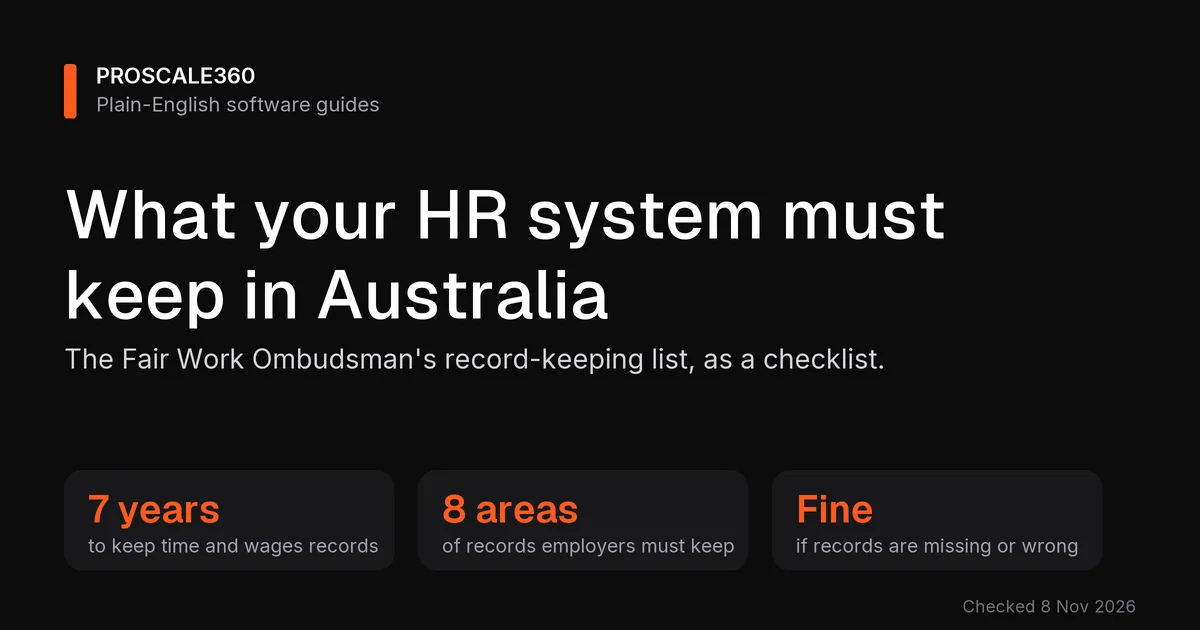
The short answer. The Fair Work Ombudsman says Australian employers must keep time and wages records for 7 years. They must be readily accessible to a Fair Work Inspector, legible and in English, and they cannot be changed except to correct an error. If records are not made or kept, or are incorrect, an inspector can issue an infringement notice, which is a fine.
What this article does. It turns the Ombudsman's record-keeping page into a checklist you can hold your spreadsheet or HR system against, and shows what a system needs to do to make it easy.
Sourced means we read the original. This is general information, not legal advice. Awards and enterprise agreements can add requirements, so check yours.
The rules in one minute
- Keep for 7 years. The Ombudsman says employers have to keep time and wages records for 7 years.
- Accessible, legible, in English. A Fair Work Inspector must be able to read them readily.
- Do not alter, except to fix an error, and never make them false or misleading. The page says it is unlawful to make or keep records you know are false or misleading.
- Keep hours worked for everyone, as best practice. The page recommends this for all employees, and says employers are required to keep them in some circumstances.
- Employees can ask to see their own records, including after they leave, and the employer must make them available.
Sourced The source is the Fair Work Ombudsman's Record-keeping page, which cites the Fair Work Act 2009 and the Fair Work Regulations 2009.
The eight areas of records
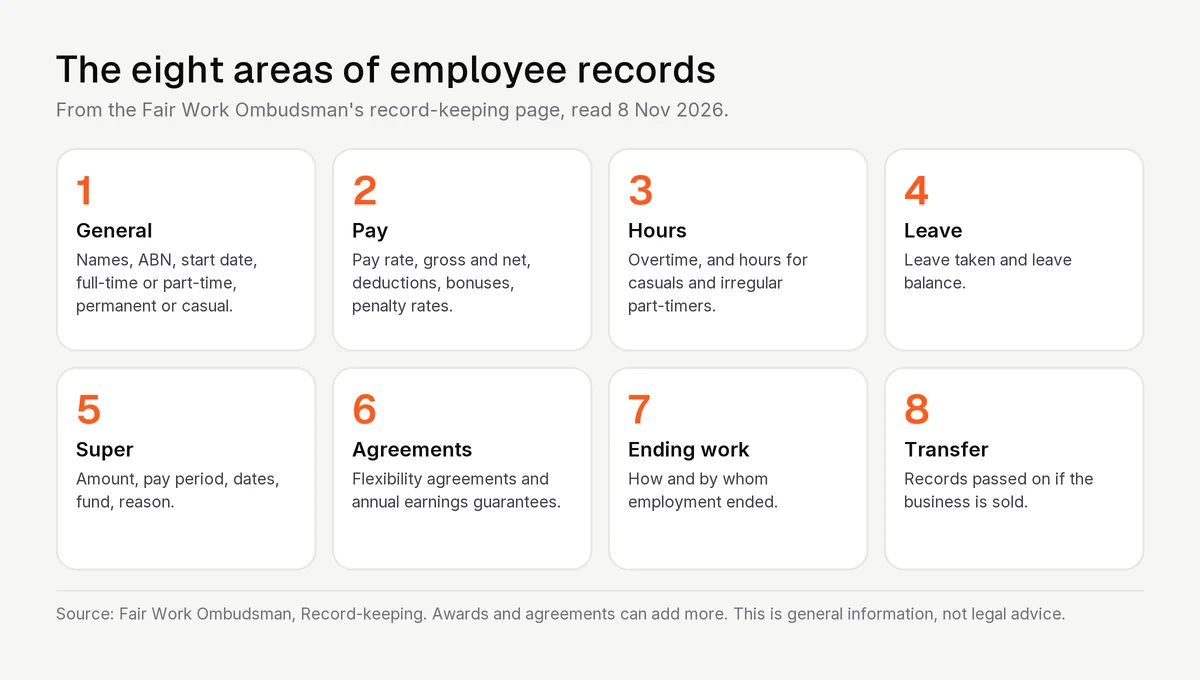
1. General
- Employer's and employee's name
- Employer's ABN (if any)
- Employee's commencement date
- Whether the employee is full-time or part-time
- Whether permanent, temporary or casual
2. Pay
- Pay rate paid to the employee
- Gross and net amounts paid
- Any deductions from the gross amount
- Details of any incentive-based payment, bonus, loading, penalty rate or other allowance paid
3. Hours of work
- Overtime: the hours worked in the day, and when they started and finished
- Hours worked by a casual or irregular part-time employee paid on time worked
- A copy of any written agreement to average work hours
4. Leave
- Any leave taken
- How much leave an employee has
- Where annual leave can be cashed out: a copy of the agreement, and the rate and date of payment
- Under many awards, a copy of an agreement for annual leave taken in advance
5. Superannuation contributions
- Amount paid, pay period and date or dates paid
- Name of the super fund
- The reason the employer paid into the fund, for example the employee's fund choice and the date they made it
6. Agreements and guarantees
- Individual flexibility agreements: the written agreement and any notice or agreement ending it
- A guarantee of annual earnings, and the date it was cancelled if it was
7. Ending employment
- How employment ended, for example by agreement, notice or summarily
- The name of the person who ended it
8. Transfer of business
- If the business is sold, the old employer gives the new employer the records of transferring employees, and the new employer must ask for records of any employee who joins within three months of the sale
Sourced Employees paid an annual wage under an award need extra records, set out on the Ombudsman's page on annualised salaries.
Who can see the records
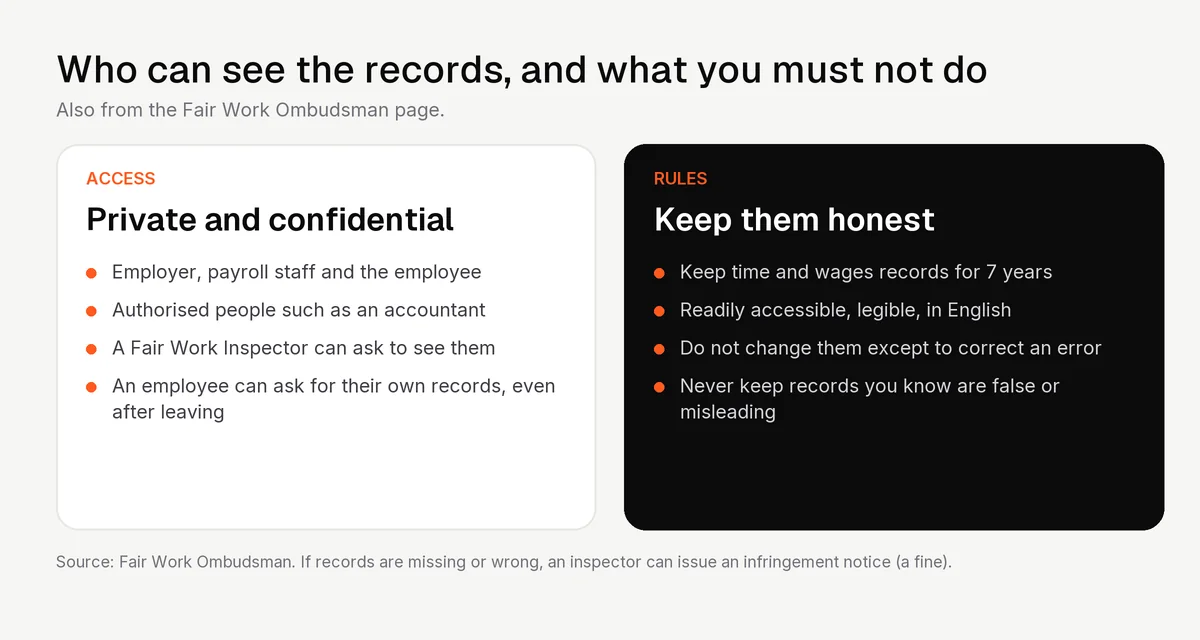
The Ombudsman says employee records are private and confidential. Only the employer, payroll staff, the employee and authorised individuals, such as an accountant, can access them. Fair Work Inspectors can also ask for time and wages records to check what an employee is entitled to and whether they were paid correctly. Sourced In a system, that means roles and permissions, not a shared spreadsheet that anyone can open.
What happens if records are missing or wrong
The Ombudsman says that if employment records are not made or kept, or are incorrect, inspectors can give employers a fine called an infringement notice. Employers can also be penalised if the Ombudsman takes a matter to court, and in some cases an employer who has not kept records or made them available for inspection may have to prove to a court that they did not underpay an employee. Sourced The page does not give dollar amounts, so we do not either.
A ten-point test for your spreadsheet or system
- Can you produce any employee's full record in one place within minutes?
- Does every employee record hold the general details listed above?
- Can you show gross, net, deductions and allowances for each pay?
- Are hours recorded for everyone, with overtime start and finish times?
- Do you track leave taken and leave balance?
- Are super details recorded: amount, period, dates, fund, reason?
- Are signed agreements (flexibility, cash-out, averaging) stored with the record?
- Is the reason and manner of ending employment recorded?
- Can you keep it all for 7 years, and see who changed what?
- Are permissions limited to the people the Ombudsman lists?
If you answer “not sure” to more than two, that is the case for tidying your records or moving to a system.
How Proscale360 is changing this
Proscale360 is a founder-led, remote-first studio: Alif Vasaya, a marketer in Sydney, and Sabina Ansari, a senior full-stack engineer and tech lead in Ahmedabad.
We want to be the go-to contact for any IT work, priced as clearly as a supermarket shelf. We take the risks. You get the result.
If you want a system shaped around this list from the start, we build HR software from $999 (US dollars), or tell us your budget and we say what fits. A first build usually covers records, leave, simple attendance and self-service, with roles and permissions; payroll with statutory filing is quoted separately. Our estimate Read what a first build covers and the HR software cost sums, then tell us what you need. Give us one task and review the working result. If you are happy, you pay. If you are not, you pay nothing. If you like it and want it better, you pay for our effort plus $10 for a round of tweaks and one meeting. The pilot page has the terms.
Founder account Between them, our founders have built integrated systems from scratch to live, including project management, ServiceNow, AI integration, and data collection and analysis, and Sabina has eight years of experience leading software projects. That is our own statement and is not independently verified. What we can show you is counted: see the ProteinPlus and Juhapura Mart case studies.
The evidence against us, and who we are not for
We are new and founder-led. There are two of us, so capacity has a ceiling, and we have two published case studies, ProteinPlus and Juhapura Mart. We are not the right choice if you need someone in your office five days a week, a 24-hour support team, or a large programme with many specialists at once.
We are not employment lawyers and do not give legal advice. A system helps you keep records. It does not tell you what your award requires.
Frequently asked questions
How long must an Australian employer keep employee records?
The Fair Work Ombudsman says employers have to keep time and wages records for 7 years.
What records does an employer have to keep?
General details, pay, hours of work, leave, superannuation contributions, individual flexibility agreements, guarantees of annual earnings, how employment ended, and transfer-of-business records, per the Fair Work Ombudsman. Awards and agreements can add more.
Can I change an employee record?
Time and wages records cannot be changed unless the change corrects an error, and they cannot be false or misleading, according to the Fair Work Ombudsman.
Who can see employee records?
The employer, payroll staff, the employee and authorised individuals such as an accountant. Fair Work Inspectors can also ask for time and wages records. Employees can ask for their own records, including after they leave.
What happens if I do not keep proper records?
An inspector can issue an infringement notice (a fine). Employers can also be penalised in court, and may have to prove they did not underpay an employee. The Ombudsman's page gives no dollar amounts.
Does Proscale360 build HR systems that follow this list?
We build HR software from $999 (US dollars), or tell us your budget. A first build covers records, leave, simple attendance and self-service. Your written plan shows how each record area is handled. This is not legal advice.
Sources
- Fair Work Ombudsman, Record-keeping, accessed 8 November 2026; cites Fair Work Act 2009 ss 535 and 539 and Fair Work Regulations 2009
- Proscale360 price list, our own published prices
General information, not legal advice. Check your award or agreement and your own obligations with a qualified adviser. Prepared by the Proscale360 team with AI assistance. Rules change, so check the Fair Work Ombudsman's page again before you rely on this.
We specialise in exactly this kind of project. Get a free consultation and a fixed quote.