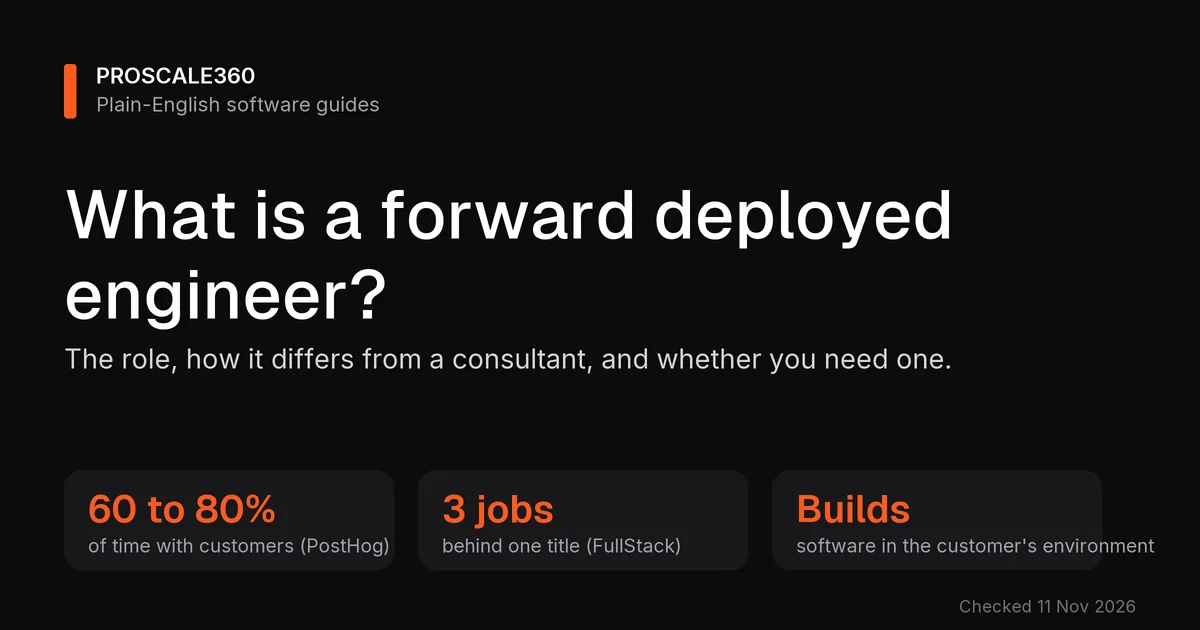
The short answer. A forward deployed engineer (FDE) is a software engineer who works embedded with a customer's team, close to the real problem, and ships working software in the customer's own environment. The role began at Palantir. It has become popular with AI companies because AI products need deep integration with each customer's data and workflows. You probably need one if you have a real AI or cloud problem to put in production and someone who can review the work. You probably do not if you want a recommendation, a demo or a fix for an unfinished product.
Who this is for. Founders and technical leads deciding whether to embed an engineer in their team, and anyone who has seen the title and wondered what it means.
Why you can trust the numbers here. We link the pages we read. Several company pages (Palantir, OpenAI, Anthropic, Salesforce) would not load for us, so we do not quote them directly.
Sourced means we read the original. Our estimate marks our judgement. Dollar amounts are US dollars as shown by each vendor.
What a forward deployed engineer is
The Pragmatic Engineer reports that the role was created at Palantir in the early 2010s, where FDEs were called Deltas, and defines an FDE as a software engineer who alternates between embedding with customer teams and working with core product engineering. Palantir's framing, per that article, is that consultants make one-off recommendations, while FDEs work with a customer over the long term and also build product features. Sourced
PostHog describes an FDE as an engineer embedded in a customer's team to close the gap between what a product does and what the customer needs. CRV describes a software engineer who embeds with customers and ships production code inside the customer's environment. Sourced
The limit. We could not open Palantir's own pages, so the origin story comes from these secondary sources. Definitions also differ by company.
What an FDE does all day
PostHog says FDEs spend 60 to 80% of their time with customers, against 10 to 20% for a typical software engineer, and build quick, customer-specific prototypes rather than general features. Sourced The Pragmatic Engineer reports that Palantir estimated about 25% of FDE time onsite and another company up to 50%. Sourced
One real example: a Databricks job post for an AI forward deployed engineer (updated 6 October 2026) describes a team that delivers professional-services engagements to help customers build and productionise AI applications. Responsibilities listed include building generative AI solutions, owning production rollouts, acting as a trusted technical adviser and influencing the product roadmap. It asks for 7 or more years of experience with applications such as retrieval, multi-agent systems and text-to-SQL, plus cloud experience. Sourced The limit: that is one Seoul job post, not a standard.
FDE, consultant, solutions engineer: what is the difference?
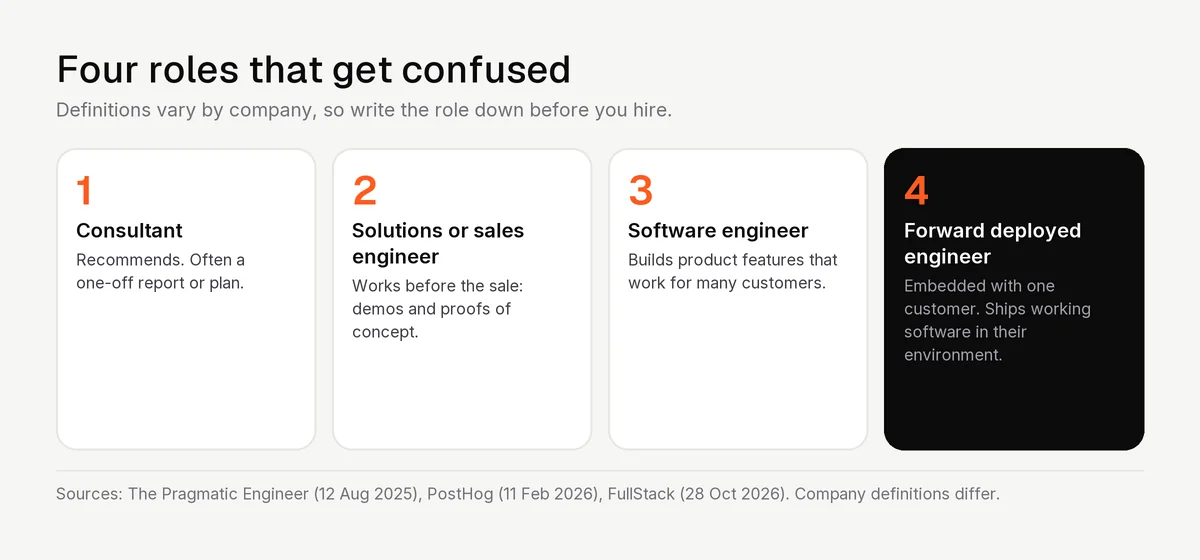
| Role | Main job | Usually works | Writes code? |
|---|---|---|---|
| Consultant | Recommends | Before or beside the work | Rarely |
| Solutions or sales engineer | Demos, proofs of concept, helps win the sale | Before the sale | Some |
| Software engineer | Builds product features for many customers | Inside the product team | Yes |
| Forward deployed engineer | Gets working software into one customer's environment | After the sale, embedded with the customer | Yes, often most of the time |
One catch. FullStack, a vendor, cites an analysis of 1,000 job posts (we did not read the underlying data) that found roughly 60% were builder roles with 70 to 90% coding, about 30% were sales-engineer roles with 30 to 40% coding, and about 10% were internal tools. Sourced In other words, the title does not tell you which job you are buying.
Why FDEs became popular
a16z argues that enterprise AI products need deep integrations and context, that the best AI application companies often have a services-style employee, sometimes called a forward deployed engineer, and that startups accept lower early margins for hands-on work to capture data and workflows. Sourced The Pragmatic Engineer reports that recruiting for the role rose noticeably from the start of 2025, driven by AI integration. Sourced
The limits. This is analysis, not a measured market study. The same newsletter later reported, citing the Wall Street Journal, that the role has historically been seen as demanding and less prestigious, and a recruiter's estimate that only about 10% of the market wants it. Sourced Treat the hype with care.
Do you need one?
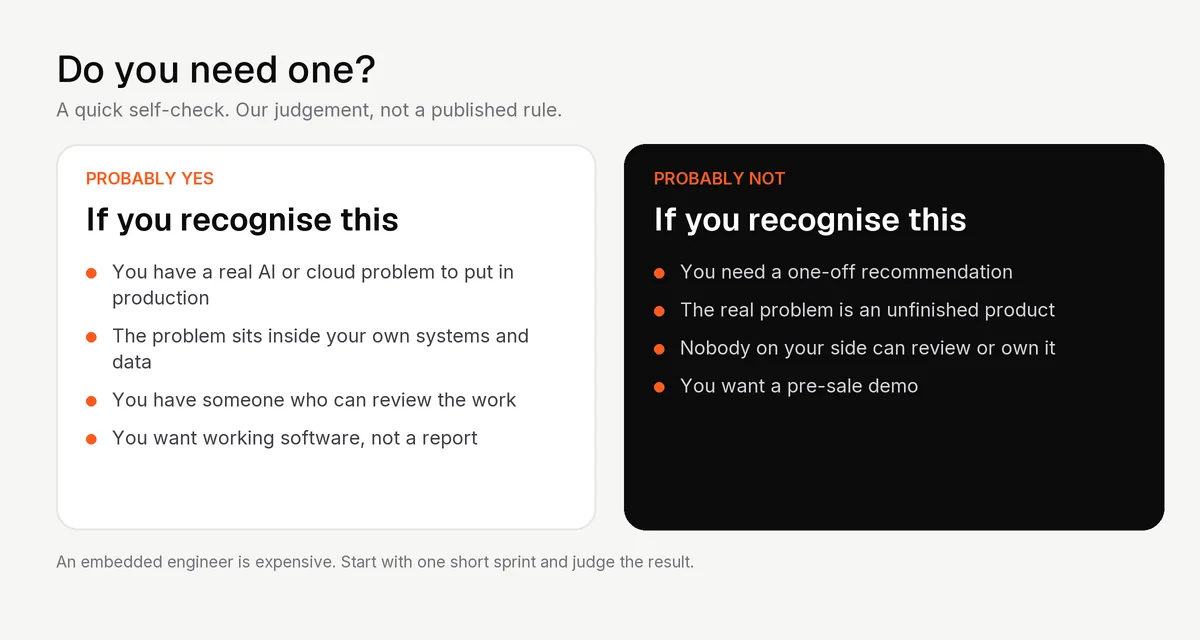
- Is there a real problem to put in production? If you only need a recommendation, hire a consultant.
- Does it live inside your own systems and data? If so, an engineer close to them helps.
- Can someone on your side review and own the result? If not, the work stalls.
- Is the real problem a product that is not finished? Constellation Research warns FDEs can become human middleware that hides incomplete tooling. Fix the product first.
- Can you start with one short sprint? You should. Judge the working result before you commit to months.
What does an embedded engineer cost?
Published prices vary widely, and all of the figures below come from vendor pages, not independent benchmarks. A.Team shows roughly $25,000 a month for a senior builder, fully loaded, and cites an Insight Partners estimate of $200,000 to $350,000 a year for a permanent in-house FDE. Entrans, in a cost guide, shows offshore engineers at $5,000 to $15,000 a month and onshore contractors at $60 to $250 an hour, though that guide contains internal inconsistencies. Sourced
The limits. Dollars are unlabelled on some pages, scopes and seniority differ, and these are marketing pages. We could not verify an FDE salary from a reliable source, so we give none. Our own services are quote only, with one itemised quote you approve first.
The risks of embedding an outside engineer
- Expectations that differ from the job. The Pragmatic Engineer reports one engineer who quit after four weeks because the role was engagement management, not engineering.
- Human middleware. Constellation Research warns FDEs can smooth over product immaturity unless they redesign workflows and teach the customer.
- One-off systems. CRV warns that if the product is not modular, FDEs build one-off systems that do not generalise.
- Knowledge in one head. Without documentation and handover, the customer is left dependent.
Sourced Most of these sources are written from the vendor side, building FDE teams. We found no neutral study of failure rates for outside embedded engineers.
How Proscale360 is changing this
Proscale360 is a founder-led, remote-first studio: Alif Vasaya, a marketer in Sydney, and Sabina Ansari, a senior full-stack engineer and tech lead in Ahmedabad.
We want to be the go-to contact for any IT work, priced as clearly as a supermarket shelf. We take the risks. You get the result.
Founder account Between them, our founders have built integrated systems from scratch to live, including project management, ServiceNow, AI integration, and data collection and analysis, and Sabina has eight years of experience leading software projects. That is our own statement and is not independently verified. What we can show you is counted: see the ProteinPlus and Juhapura Mart case studies.
We supply embedded engineers for AI applications and cloud infrastructure, and we start with a written role description so expectations match the job. You get a thin working slice early, weekly reporting, and a handover so you are not dependent on us. See forward deployed engineers. Give us one task and review the working result. If you are happy, you pay. If you are not, you pay nothing. If you like it and want it better, you pay for our effort plus $10 for a round of tweaks and one meeting. The pilot page has the terms.
The evidence against us, and who we are not for
We are new and founder-led. There are two of us, so capacity has a ceiling, and we have two published case studies, ProteinPlus and Juhapura Mart. We are not the right choice if you need someone in your office five days a week, a 24-hour support team, or a large programme with many specialists at once.
If you need a named engineer from a specific AI lab, certified-vendor status, or a long public record, we are not the right choice. We also publish no results for embedded engagements yet. Read our honest guide to alternatives to compare.
Frequently asked questions
What is a forward deployed engineer?
A software engineer who works embedded with a customer's team and ships working software in the customer's own environment, close to the real problem. The role began at Palantir, where FDEs were called Deltas.
What does a forward deployed engineer do?
They build and ship software for one customer, often prototypes first, then production. PostHog says they spend 60 to 80% of their time with customers. They also advise and feed what they learn back to the product team.
How is an FDE different from a solutions engineer or a consultant?
A consultant usually recommends, and a solutions or sales engineer usually works before the sale, often on proofs of concept. An FDE works after the sale, embedded with one customer, and ships production software. Definitions vary by company.
Do forward deployed engineers write code?
Often a lot, but not always. An analysis of 1,000 job posts cited by FullStack found about 60% were builder roles with 70 to 90% coding and about 30% were sales-engineer roles with 30 to 40% coding. We did not read the underlying data.
How much does an embedded engineer cost?
Vendor pages vary widely: one shows roughly $25,000 a month for a senior builder fully loaded, and another shows offshore engineers at $5,000 to $15,000 a month. These are marketing pages, not benchmarks. We could not verify a salary figure. Our services are quote only.
Why are forward deployed engineers in demand?
a16z argues enterprise AI products need deep integration with each customer's data and workflows. Recruiting for the role rose from early 2025, according to The Pragmatic Engineer. It is analysis, not a measured study, and the role is also described as demanding.
Do I need a forward deployed engineer?
Probably if you have a real AI or cloud problem to put in production, inside your own systems, and someone who can review the work. Probably not if you need a recommendation, a demo, or a fix for an unfinished product.
Sources
- The Pragmatic Engineer: What are forward deployed engineers, and why are they in demand?, 12 August 2025; read 11 November 2026
- The Pragmatic Engineer: Is the FDE role becoming less desirable?, 26 March 2026; read 11 November 2026
- PostHog: What is a forward deployed engineer?, 11 February 2026; read 11 November 2026
- CRV: The forward deployed engineer, 18 May 2026; read 11 November 2026
- a16z: Trading margin for moat, why the forward deployed engineer is the hottest job in startups, 4 June 2025; read 11 November 2026
- Constellation Research: Forward deployed engineers, promise and peril, 1 February 2026; read 11 November 2026
- FullStack: Three jobs, one title, 28 October 2026; a vendor; read 11 November 2026
- A.Team: Hire forward deployed engineers, a vendor; undated; read 11 November 2026
- Entrans: Forward deployed engineer cost, 29 September 2026; a vendor guide with inconsistencies; read 11 November 2026
- Proscale360 price list, our own published prices, US dollars
General information. Most sources are written from the vendor side. Palantir, OpenAI, Anthropic and Salesforce pages did not load for us, so we cite none directly, and we give no salary figure we could not verify. Prepared by the Proscale360 team with AI assistance. Checked 11 November 2026.
We specialise in exactly this kind of project. Get a free consultation and a fixed quote.