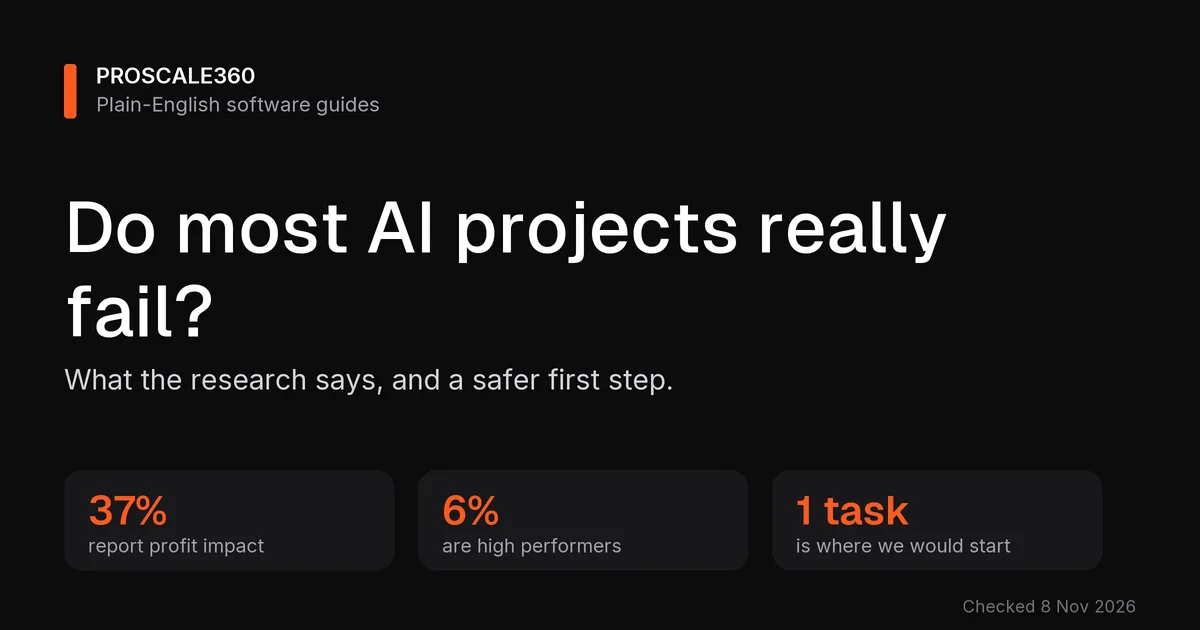
The short answer. You will often read that “80% of AI projects fail”. When we traced it, the 80% in RAND's well-known report is a figure it attributes to other people (“by some estimates”), not something RAND measured. What RAND did measure is why projects go wrong, from 65 expert interviews. The best recent hard number we found is from McKinsey's 2026 survey: only 37% of organisations report any profit impact from AI, and only 6% are what McKinsey calls high performers, even though 80% of people say AI makes them personally more productive.
What that means for a small business. The gap is not about the technology. It is about picking a problem that is too big, too vague or not worth solving. So the safer way to start is one small, measurable task, checked by a person, before anything bigger.
Sourced means we read the original. Our estimate marks our own judgement. Price list means our published price. Dollar amounts are US dollars.
Where the “80% fail” line comes from
The RAND Corporation published The Root Causes of Failure for Artificial Intelligence Projects and How They Can Succeed in August 2024. Its summary says that “by some estimates” more than 80 percent of AI projects fail, twice the rate of IT projects that do not involve AI, and it cites another author for that figure. Sourced RAND's own contribution was a set of interviews: 65 people with at least five years of experience building AI, 50 from industry and 15 from academia, interviewed between August and December 2023.
Three limits matter before you quote it. First, RAND defined failure as a project the organisation perceived as a failure, technical or business. That is a feeling, not an audit. Second, the report says most interviewees were engineers rather than executives, so the results may lean toward blaming leadership. Third, it looked at machine-learning projects and left out projects that only used a pretrained language model through prompts, which is how most small businesses meet AI today. So it tells us a lot about why serious AI builds go wrong, and less about a small business adding a chatbot or an automation.
Why projects go wrong, in plain words
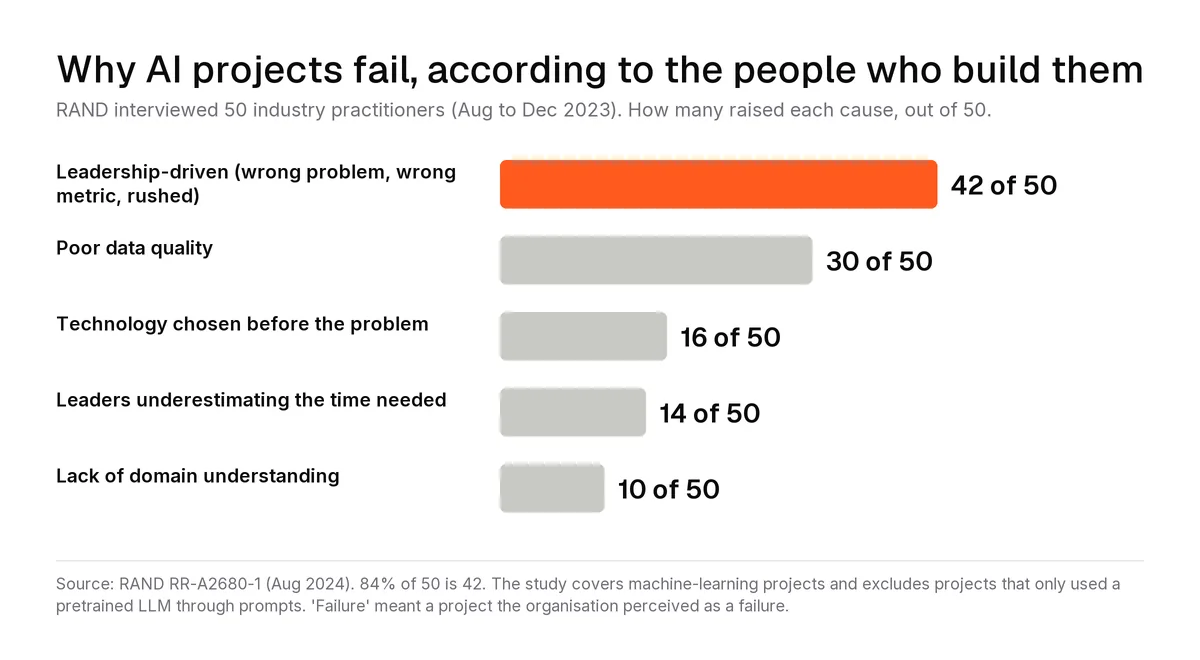
RAND found five root causes. Here they are, with how often interviewees raised them (out of the 50 from industry).
- The wrong problem, or the wrong measure of success. 84% of the industry interviewees (42 of 50) cited at least one leadership-driven cause. RAND's example: a business asks for the price that sells the most, when it actually needs the price that earns the most profit. Others were using AI where a few simple rules would do, expecting certainty from a tool that is probabilistic, and underestimating the time it takes. 14 of 50 said leaders underestimated the time.
- Data that is not fit for the job. 30 of 50 raised data quality. A report built for accounting may not hold what an AI tool needs.
- Technology before the problem. 16 of 50 described teams chasing the latest tools instead of the user's problem.
- No plumbing. Without systems to clean data and deploy and monitor models, projects stall or fail silently.
- Problems too hard for the technology. AI is not a magic wand, and some tasks, especially ones needing subjective judgement, are still beyond it.
RAND's advice follows from the causes: make sure the technical people understand the real purpose, choose problems worth at least a year of effort, focus on the problem rather than the technology, invest in the plumbing, and ask technical experts whether the task is feasible at all.
What the surveys say about results
| Number | What it is | Type | Where it comes from |
|---|---|---|---|
| 37% | Organisations reporting at least some profit (EBIT) impact from AI, unchanged since 2025 | Sourced | McKinsey State of AI 2026, 1,719 respondents, 97 countries |
| 6% | AI “high performers”: 5% or more of EBIT from AI, and describing the impact as significant | Sourced | McKinsey State of AI 2026 |
| 80% | People saying AI improved their own productivity | Sourced | McKinsey State of AI 2026 |
| 44% | Organisations scaling AI across the enterprise, up from 38% | Sourced | McKinsey State of AI 2026 |
| 15.8% / 15.2% / 22.6% | Average revenue increase, cost saving and productivity gain reported by early generative AI adopters | Sourced | Gartner survey of 822 business leaders, Sep to Nov 2023 |
| 40%+ | Agentic AI projects Gartner predicts will be cancelled by the end of 2027 | Sourced | Gartner press release, 25 June 2025 (a prediction) |
McKinsey, 2026. The survey ran from 4 May to 8 June 2026 with 1,719 respondents in 97 countries. Sourced Two things stand out. The share reporting profit impact has not moved, at 37%, even as the share scaling AI rose from 38% to 44%. And the 6% of high performers differ in how they work: nearly three quarters report fundamentally redesigning workflows because of AI, against about a quarter of others, and they are about twice as likely to say senior leaders show commitment and that there are defined ways to measure impact. In plain words: the winners changed how the work is done, they did not bolt a tool on top.
The limits: respondents report their own results, 36% work at organisations with more than $1 billion in revenue, and large companies are ahead of small ones. For example, 40% of large organisations report scaling AI agents against a flat 22% of smaller ones. We did not find an equally rigorous study of Australian small businesses, so treat these as a guide, not a forecast for your shop.
Gartner. In July 2024, Gartner predicted that at least 30% of generative AI projects would be abandoned after the proof-of-concept stage by the end of 2025, and said costs are not as predictable as with other technologies. Its survey of 822 business leaders found average reported gains of 15.8% revenue, 15.2% cost savings and 22.6% productivity, though it warned benefits are specific to company, use case and role. Sourced In June 2025 it predicted that over 40% of agentic AI projects will be cancelled by the end of 2027 because of escalating costs, unclear business value or inadequate risk controls, and noted that many vendors engage in “agent washing”, rebranding existing products. It estimated only about 130 of the thousands of agentic AI vendors are real, and that many use cases sold as agentic do not need an agentic approach. Sourced These are analyst predictions, not measured outcomes, and the early-adopter survey figures are self-reported.
Start simple: the advice from the builders
Anthropic, the company that makes Claude, published an engineering guide to building agents in December 2024. Its advice: find the simplest solution possible and only add complexity when needed. It separates workflows, where code follows a fixed path and uses a language model at set steps, from agents, where the model decides its own steps. Workflows give predictability for well-defined tasks; agents suit cases that need flexibility at scale, and they come with higher costs and the potential for compounding errors. For many applications, it says, a single well-prompted call with the right information is enough. Sourced That lines up with Gartner's warning that many “agent” projects do not need to be agents. For a first project, a fixed set of steps you can inspect beats an autonomous system you cannot.
Do not skip privacy
The Office of the Australian Information Commissioner (OAIC) published guidance on privacy and commercially available AI products on 21 October 2024, updated 17 January 2025. Its key points: privacy obligations apply to any personal information put into an AI system and to AI output that contains personal information; businesses should update their privacy policies to say how they use AI; and, as best practice, organisations should not enter personal information, especially sensitive information, into publicly available generative AI tools. It says checking a product should not be a “set and forget” exercise and should cover how human oversight is built in. Sourced Whether the Privacy Act applies to your particular business depends on your circumstances, so check with a qualified adviser. For a first task, the easy safe choice is one that does not need customer personal information at all.
The one-task way to start
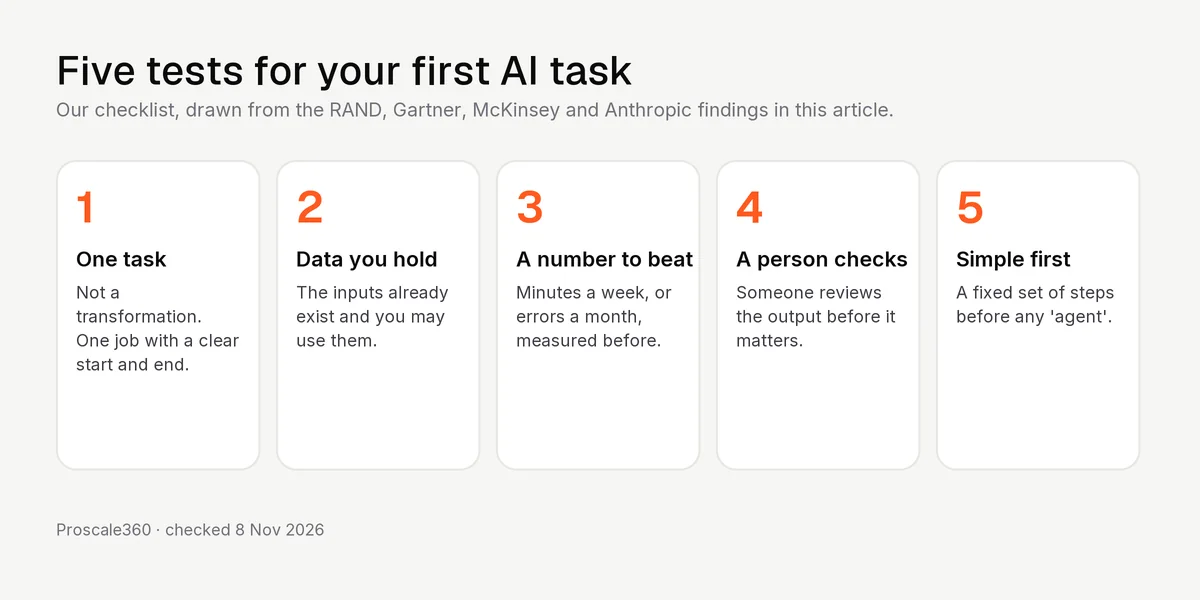
Put the research together and a plan falls out. This is our own checklist, built from the sources above. Our estimate
- One task. Pick one job with a clear start and end: answering the same five customer questions, summarising incoming enquiries, drafting quotes from a template. RAND's first cause is a vague problem, so make it specific.
- Data you already hold and may use. RAND's second cause is data. Start where the inputs already exist, ideally with no personal information.
- A number to beat. Write down how long the task takes now, or how many mistakes happen in a month. McKinsey's high performers are twice as likely to have defined ways to measure impact. If you cannot measure it, you cannot tell whether it worked.
- A person checks the output. AI is probabilistic, as RAND notes. Someone reads the result before it reaches a customer.
- Simple first. A fixed set of steps before any autonomous agent, as Anthropic and Gartner both suggest.
Then decide with evidence. If the number improved and the checking is not a burden, scale it or pick the next task. If not, you have spent a small amount to learn something real, rather than a large amount to find out the same thing later. Redesigning the workflow, which is what McKinsey's high performers do, comes after you have proved one piece works.
Our where to start with AI page walks through this for a business with no AI experience, and the AI project cost calculator helps you size a task before you ask anyone for a price. For the wider picture, see AI and automation in Australia.
How Proscale360 is changing this
Proscale360 is a founder-led, remote-first studio: Alif Vasaya, a marketer in Sydney, and Sabina Ansari, a senior full-stack engineer and tech lead in Ahmedabad.
We want to be the go-to contact for any IT work, priced as clearly as a supermarket shelf. We take the risks. You get the result.
That sentence is easy to write. Here is what it means for AI work:
- The pilot is one task, with the risk on us. Give us one task and review the working result. If you are happy, you pay. If not, you pay nothing. If you like it and want it better, you pay our effort plus $10 for tweaks and one meeting. See the pilot.
- AI does the routine typing, people do the checking. That is how we build, and it is how we suggest you use it. Our summary of the research on AI and developer speed, including the studies that show no gain on large old codebases, is on the AI coding productivity studies page.
- Published prices for the common cases. Price list A simple AI integration is $480 (about A$683) and an advanced one is $1,200 (about A$1709), scoped before we start. Australian dollar figures use the RBA rate of 2 November 2026 (A$1 = US$0.7023); your quote states the Australian figure. For larger agent and language-model builds we quote on request, because the honest price depends on the task. See AI services, language model development and AI agent development.
The evidence against us, and who we are not for
We are small and new, with two people and two published case studies, ProteinPlus and Juhapura Mart. We have no public record of large enterprise AI programmes, and we will not pretend to. If you need a multi-team transformation with a long list of specialists, a larger firm is the right choice. If you want to try one task, learn something real and keep control of the cost, that is what we are built for.
Frequently asked questions
Do 80% of AI projects really fail?
That figure appears in a 2024 RAND report as an estimate it attributes to other authors, not something RAND measured. RAND's own work was 65 interviews with experienced AI practitioners about why projects fail, and it defined failure as a project the organisation perceived as a failure.
How many organisations see a profit impact from AI?
McKinsey's 2026 survey of 1,719 respondents in 97 countries found 37 percent report at least some EBIT impact from AI, unchanged since 2025, and about 6 percent are high performers. 80 percent say AI improved their own productivity.
What does Gartner predict about AI projects?
In July 2024 Gartner predicted at least 30 percent of generative AI projects would be abandoned after proof of concept by the end of 2025. In June 2025 it predicted over 40 percent of agentic AI projects will be cancelled by the end of 2027, citing escalating costs, unclear business value or inadequate risk controls. Both are predictions.
Where should a small business start with AI?
With one task that has a clear start and end, uses data you already hold and may use, has a measurable baseline, has a person checking the output, and uses a fixed set of steps rather than an autonomous agent. This is our checklist drawn from the research.
Is it safe to put customer information into AI tools?
The OAIC says privacy obligations apply to personal information put into an AI system, and recommends as best practice that organisations do not enter personal information, particularly sensitive information, into publicly available generative AI tools. Check your own obligations with a qualified adviser.
What does Proscale360's AI pilot cost?
The pilot is one task: if you are happy, you pay; if not, you pay nothing; if you like it and want it better, you pay our effort plus $10 for tweaks and one meeting. Our published AI integration prices are $480 for simple and $1,200 for advanced, in US dollars.
Sources
- RAND, The Root Causes of Failure for Artificial Intelligence Projects and How They Can Succeed (RR-A2680-1), published 13 August 2024; accessed 8 November 2026
- McKinsey, The state of AI in 2026: On the road to ROI, 25 August 2026; accessed 8 November 2026
- Gartner, Predicts 30% of Generative AI Projects Will Be Abandoned After Proof of Concept By End of 2025, July 2024; accessed 8 November 2026
- Gartner, Predicts Over 40% of Agentic AI Projects Will Be Canceled by End of 2027, 25 June 2025; accessed 8 November 2026
- Anthropic, Building effective agents, 19 December 2024; accessed 8 November 2026
- OAIC, Guidance on privacy and the use of commercially available AI products, published 21 October 2024, updated 17 January 2025; accessed 8 November 2026
- Reserve Bank of Australia, Exchange rates, rates for 2 November 2026
- Proscale360 price list, our own published prices
General information, not financial, legal or technology advice. Prepared by the Proscale360 team with AI assistance. Every figure was checked against the sources above on 8 November 2026. Gartner figures are predictions and survey results self-reported by respondents. Check again before you rely on them.
We specialise in exactly this kind of project. Get a free consultation and a fixed quote.