AV drawings, schedules and as-builts, produced to your documentation standard.
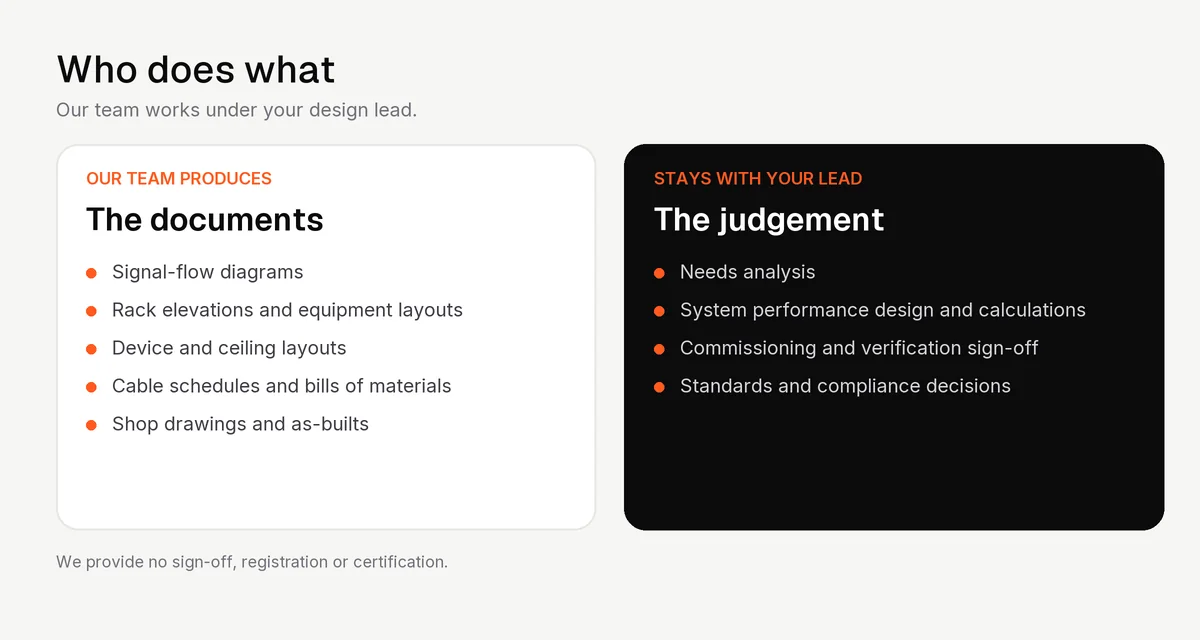
Audiovisual systems are designed, drawn and verified in stages. We supply managed drafting and design support for the documentation-heavy parts: signal flow, rack layouts, device and ceiling layouts, cable schedules, bills of materials, shop drawings and as-built sets, working to your standards under your design lead.
Is this page for you?
This is for you if you design or install AV systems and need documentation produced. By the end of this page you will know which documents we produce at each stage.
We prepare the design documents for rooms with screens, speakers and microphones, so the installer knows exactly what to put where.
- AV:
- Audio and video equipment, such as screens, speakers and conference systems.
- Schematic:
- A diagram showing how each device connects to the others.
- Bill of materials:
- A list of every item and quantity needed for the job.
- AV designers and integrators short of drafting capacity.
Signal-flow diagrams, rack elevations, device layouts, cable schedules, shop drawings and as-builts.
- Project managers who need a document register.
A register of what is produced, by whom, in the way AVIXA's documentation standard frames it.
Situations we are called for
- You design or install AV and need documents produced. Signal-flow diagrams, rack elevations, device layouts, cable schedules, shop drawings and as-builts.
- You need a clear register of what is produced. A document register, in the way AVIXA's documentation standard frames it.
Questions people ask, answered short
- What AV documents do you produce?
- Signal-flow diagrams, rack elevations, device layouts, cable schedules, shop drawings and as-builts.
- Do you commission systems?
- No. Needs analysis, performance design and commissioning sign-off stay with you.
- What is an as-built?
- The final drawing showing what was actually installed.
Us, or something else?
- Use a design consultant for needs analysis and sign-off. Use us for the documentation work.
Not a fit if you need needs analysis, performance design or commissioning sign-off from us.
Tell us the project, the software and your drawing standard. We reply with a document register and a quote.
AV projects go wrong on documents and coordination more than on equipment
The equipment is rarely the problem. Unclear documents, late coordination and unclear responsibility are.
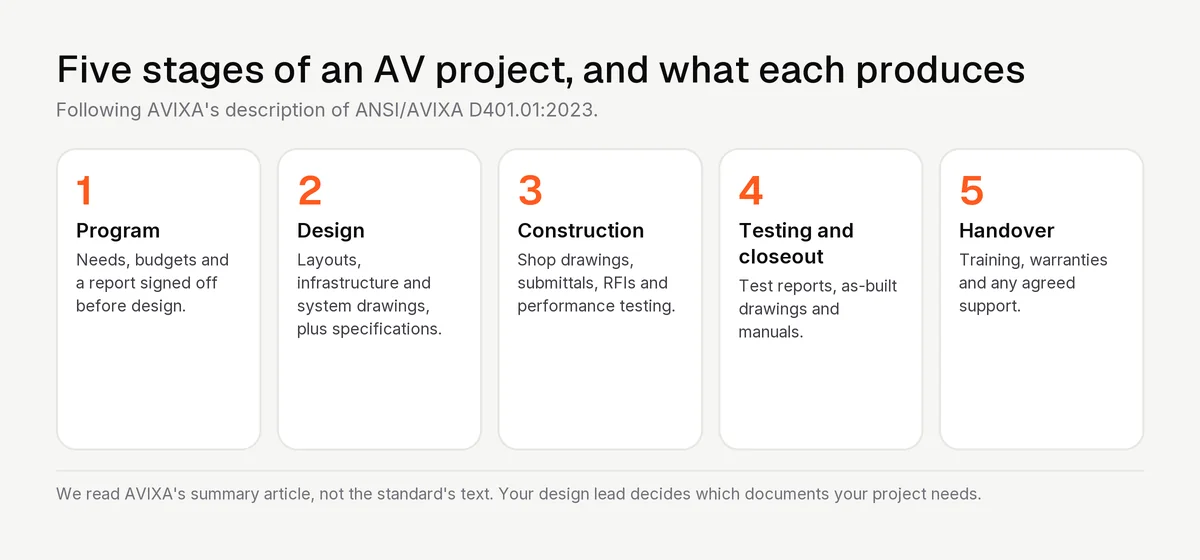
AVIXA's ANSI-accredited documentation standard, published May 2023, frames which documents an AV project needs, who creates them and how delivery is tracked.
Limit: We read AVIXA's page and its summary article, not the standard's own text.
Facility managers quoted by AVIXA and IFMA mention AV sharing networks and power with other systems, limited AV expertise, ongoing licensing and firmware costs, staff turnover and inconsistent control interfaces.
Limit: A practitioner article (8 Dec 2025), not survey data.
AVIXA's designer credential is for people who assess needs, create solutions and ensure every project is verified and documented. It requires an active base CTS, and AVIXA recommends 3 to 4 years of experience.
Limit: We do not claim the credential for our team. If an individual holds one, we show the certificate.
Where it usually goes wrong,
and what we do instead
Not slogans. Each row is a specific way this work goes wrong, and the specific thing we do about it.
Drawings issued with no agreed document list.
We agree a document register first: what is produced, by whom, and how delivery is tracked.
AV coordinated late, causing ceiling, conduit and power conflicts.
We check device and conduit locations against architectural, MEP and IT drawings and list conflicts early for your lead.
Blurred sign-off.
Needs analysis, performance design and commissioning sign-off stay with your design lead.
Claims that cannot be checked.
On request we share a due-diligence pack: the delivery team's credentials, the legal documents that cover the work, the current process, and client references you can call.
Every row rests on a source listed at the foot of this page, with its limits stated beside it. We have not read every review of every provider, so we do not claim to speak for all of them.
Start with the quote, or try one small task first and pay only if you are happy.
What we do
for you
Signal-flow and system diagrams
Functional diagrams that show how sources, processing, control and displays connect.
Rack elevations and equipment layouts
Rack designs and equipment-room layouts drawn to your templates.
Device and ceiling layouts
Speakers, displays, microphones, cameras and controls placed on the architectural plans, with mounting notes.
Cable schedules and bills of materials
Cable lists, labels and equipment schedules that match the drawings, so the installer and the buyer work from one source.
Shop drawings
Installation drawings derived from the design documents, for submittals and construction.
As-builts and closeout
Updated drawings and records that match what was installed, with test records filed.
Step by step,
from brief to result
What you do, what we do, and what you see at each step. You approve the plan and the quote before any work starts.
Agree the document list
Tell us which documents the project needs and your drawing standard.
List the documents, who produces each and how delivery is tracked, in the way AVIXA's documentation standard frames it.
A one-page document register.
Trial one package
Give one room type or one system.
Draw it as a trial. Happy, you pay. Not happy, you pay nothing.
A real package to check against your standard.
Produce to your templates
Share templates, symbols and software versions.
Draw in your template, self-check against a checklist and flag questions early.
Drawings in your format and a question log.
Coordinate with other trades
Share the architect, MEP and IT drawings.
Check devices, conduits, power and ceilings against those drawings and list conflicts for your lead.
A coordination list for your lead.
Close out
Review as-builts and test records.
Update drawings to match what was installed and file records.
A final set and a handover note.
What you
receive
- A document register
- Signal-flow and system diagrams
- Rack elevations and equipment layouts
- Device and ceiling layouts
- Cable schedules and bills of materials
- Shop drawings
- As-builts and a closeout set
- Daily, weekly or monthly reporting as you choose
- A short lessons log: what we learned and changed
What you
can expect
- Documents that match the design intent and each other
- Fewer late surprises on site
- More capacity for your design lead to focus on judgement
- Files in your formats and your templates
These are what to expect, not guarantees. Results depend on your starting point, your market and the decisions you make. Timings are our founders' experience, and your plan states them before we start.
Experienced people,
in a founder-led, honest studio
We are a new, founder-led studio, and we say so on purpose. The experience behind it is real.
“We produce the documentation-heavy parts of AV design, under your design lead and to your standard. We make no claim to AVIXA certification for our team unless an individual's certificate exists, and then we show it.”
Check us
Read the founders' profiles, open our case studies, or run a pilot task before you pay.
Who this is
not for
We would rather say so now than after you have paid.
- You need needs analysis, performance design or commissioning sign-off from us. That stays with your design lead.
- You want certified AV designer status. We claim none. Ask for any individual's certificate, such as AVIXA's CTS-D, and we will show it only if it exists.
- You need a 24-hour support team or staff in your office.
Not sure? Book a free ten-minute call and we will tell you honestly.
Audiovisual design support:
common questions
We do not publish a price for this work because every project differs. You request a quote and we send one itemised quote that you approve first.
What does an AV design project produce?
AVIXA describes an AV project as programme, design, construction, testing and closeout. The documents include architectural drawings (device locations, sightlines, mounting), infrastructure drawings (pathways, terminations, equipment rooms), AV system drawings (functional diagrams, rack elevations, custom details) and specifications, then shop drawings, test reports and as-builts.
Which standards do AV projects use?
AVIXA publishes ANSI-accredited standards, including ANSI/AVIXA D401.01:2023 for documentation requirements and D402.02:2013 (R2024) for performance verification. We work to the standard and templates your project names. In Australia, AV also interacts with building, electrical and acoustic requirements, which your design lead confirms.
What is a CTS-D?
AVIXA's Certified Technology Specialist-Designer credential, which AVIXA describes as for people who assess needs, create solutions, and ensure every project is verified and documented. It requires an active base CTS, and AVIXA recommends 3 to 4 years of experience. We do not claim the credential for our team. If a person holds one, we show the certificate.
What do clients struggle with?
Facility managers quoted by AVIXA and IFMA mention AV sharing networks and power with other systems, limited AV expertise, ongoing licensing and firmware costs, staff turnover and inconsistent control interfaces. Coordination early with architects, MEP and IT, and a clear document list, reduce the surprises.
Do you provide sign-off?
Our team produces drawings, models and schedules under your registered or licensed design lead, who reviews the work and signs it. We do not provide engineering sign-off, registration or licences.
What does it cost?
We do not publish a price. Request a quote for one itemised quote you approve first, or start with a trial package and pay only if you are happy.
Can we verify your team?
On request we share a due-diligence pack: the delivery team's credentials, the legal documents that cover the work, the current process, and client references you can call.
Where the facts on this page come from
- AVIXA: ANSI/AVIXA D401.01:2023, Documentation Requirements for Audiovisual Systems
- AVIXA: What do facility managers wish AV specialists knew? (8 Dec 2025)
- AVIXA: CTS-D, Certified Technology Specialist-Designer
- AVIXA: Guidelines for managing and coordinating AV system design and installation following AVIXA standards
- AVIXA: Published standards (catalogue read 11 Nov 2026, first items only)
- Proscale360: the pilot, one task, pay only if you are happy
Sources read on 11 November 2026. General information, not legal, tax, security or financial advice. We do not claim cloud-provider certifications or partner status on this page. Rules and prices change, so check the source before you rely on it.
Often needed
alongside this
Design and engineering support
Managed drafting, BIM and design support for AV, security systems and MEP. Quote only.
Electronic security systems design support
Camera, access control and intruder-detection documents under your design lead. Quote only.
MEP design and BIM support
BIM modelling, coordination and drawings for MEP, under your registered engineer. Quote only.
Tell us what you need.
Get one clear quote.
Describe it in a few lines. A founder reads it and replies with questions or one itemised quote that you approve before any work starts. Prefer to start small? Try the pilot: one task, and you pay only if you are happy.
- CompareAny quote, in our calculator
- Real buildProteinPlus, counted
- $145Website, from
- $0if you're not happy
- $580Online store
- You ownthe code
- 6 stepsHow we work
- AI + peopleAI builds, people test
- Your quote?We price it next to ours
Don't pay 2016 prices for software.
Give us one task. Happy, you pay. Not happy, you pay nothing. We take the risk.
See all nine campaignsWe take the risk
Give us one task. You see a working result before you decide. Happy, you pay. Not happy, you pay nothing.
How you payHow we work
A free call of about ten minutes, a free plan and one itemised quote, a pilot, your review, then go live with support. Six steps, nothing hidden.
See the six stepsPrices you can check
Website from $145. Online store $580. Custom software from $720. Send us any quote you hold and we price the same work next to it. A small upgrade (about an hour of work or less) is about $10.
See the price list“Everything is possible. It doesn't have to cost a fortune, and nothing should hold your ideas back. Things are changing, and you should know it. We have the experience in what we do, so you can do what you're good at: running your business and steering its strategy. You shouldn't have to learn digital marketing or web development, overpay, or wait months, quarters or years for a project to earn revenue.”
“Technology and coding are not as far out of reach as they seem. I have led projects for eight years, and I bring everything I have built and learned to yours. I take care of the details, the security, the updates and the technology stack, so you don't have to worry about any of it.”
In the founders' own words, lightly edited for clarity.
To be the go-to contact for any IT work, priced so clearly it feels as easy as picking something off a supermarket shelf.
We take the risks. You get the result.
Run by Alif Vasaya (Sydney) and Sabina Ansari (Ahmedabad). A new, founder-led studio, and we say so.