Security system drawings and schedules, built from your risk assessment.
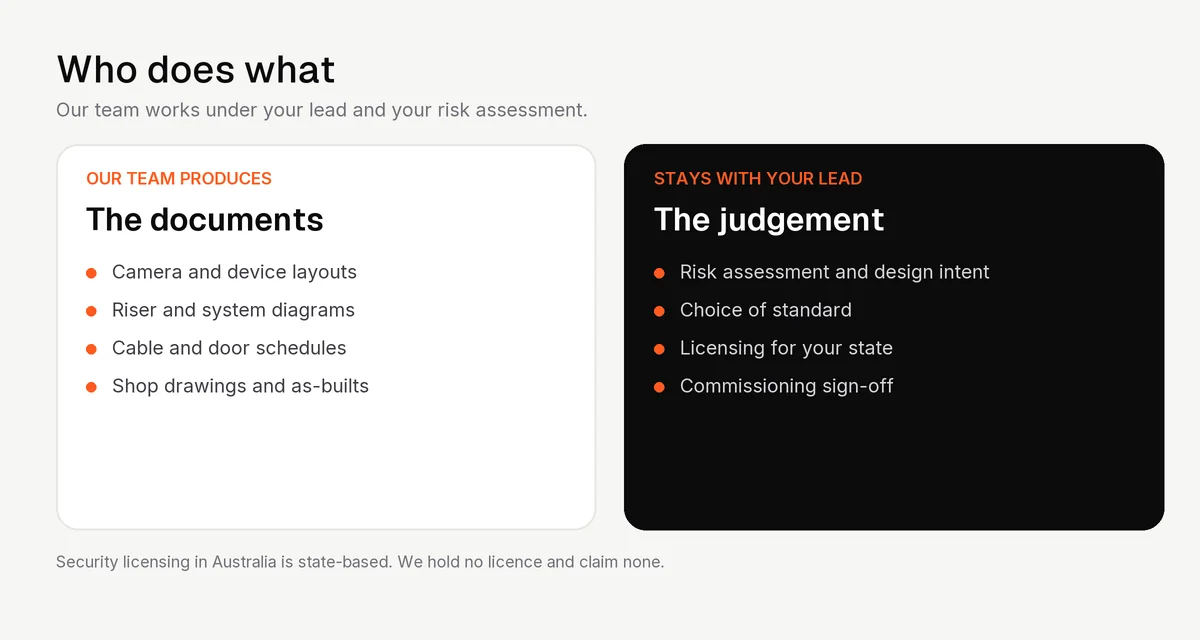
Electronic security systems (ESS) protect a site with video surveillance, access control, intruder detection and the links between them and other building systems. We supply managed drafting and design support for the documents: camera and door layouts, riser and system diagrams, cable and door schedules, shop drawings and as-builts, working under your design lead and your risk assessment.
Is this page for you?
This is for you if you design or install security systems and need the documents. By the end of this page you will know what we draw and what stays with your lead.
We draw up the plan for cameras, door access and alarms for a building, so installers have clear drawings and a parts list.
- ESS:
- Electronic security systems, such as cameras, door access and alarms.
- Access control:
- Cards or codes that decide who can open which door.
- CCTV:
- A closed camera system that records what happens in a place.
- Security integrators short of drafting capacity.
Camera, door and detector layouts, risers, schedules, shop drawings and as-builts.
- Teams that need interfaces agreed before site.
An interface schedule with fire alarm and other systems.
Situations we are called for
- You design or install security systems and need drawings. Camera, door and detector layouts, risers, schedules, shop drawings and as-builts.
- Interfaces with fire alarm and other systems are unclear. An interface schedule agreed before site.
Questions people ask, answered short
- What security design documents do you draw?
- Camera, door and detector layouts, risers, schedules, shop drawings and as-builts.
- Do you do the risk assessment?
- No. It stays with your lead, and we hold no security licence.
- What is an interface schedule?
- A table that says how the security system connects to other systems, such as fire alarm.
Us, or something else?
- Use a licensed consultant for risk assessment. Use us for drafting capacity.
Not a fit if you need us to carry out the risk assessment, hold a security licence or sign off.
Tell us the systems, the standards your project cites and your templates. We reply with a document register and a quote.
Security system documents depend on decisions made before the first drawing
A camera layout is only as good as the risk assessment behind it, and the standards cover how to build, not what to protect.
AS/NZS 2201.1:2007 covers the design, installation, commissioning and maintenance of intruder alarm systems at client premises, but it does not set the extent of protection required. That is a risk-assessment decision.
Limit: Read on a New Zealand building-code page that reproduces the scope. The standards store lists the standard as pending revision, so check the current edition.
The AS 4806 CCTV series was last updated in 2008, and a 2015 practitioner thread called it largely fallen into disuse for private installations. Store listings of its status conflict.
Limit: A forum thread, not an authority. We do not call AS 4806 current and ask which standard your project names.
NCC 2022 lists the AS 1670 series for fire detection, warning, control and intercom systems, in its 2018 editions, which matters where door release and other security links depend on the fire alarm.
Limit: From the NCC 2022 referenced-documents table. Newer editions may exist, and we did not verify them.
Where it usually goes wrong,
and what we do instead
Not slogans. Each row is a specific way this work goes wrong, and the specific thing we do about it.
Device layouts drawn without a risk assessment or design intent.
Layouts follow your risk assessment and design intent, and we ask for them before drawing.
Security and fire-alarm interfaces agreed late.
We produce an interface schedule so the trades agree before site.
Uncertainty over which standard applies.
We ask which standard your project names and work to it, and we flag where the reference looks dated.
Claims that cannot be checked.
On request we share a due-diligence pack: the delivery team's credentials, the legal documents that cover the work, the current process, and client references you can call.
Every row rests on a source listed at the foot of this page, with its limits stated beside it. We have not read every review of every provider, so we do not claim to speak for all of them.
Start with the quote, or try one small task first and pay only if you are happy.
What we do
for you
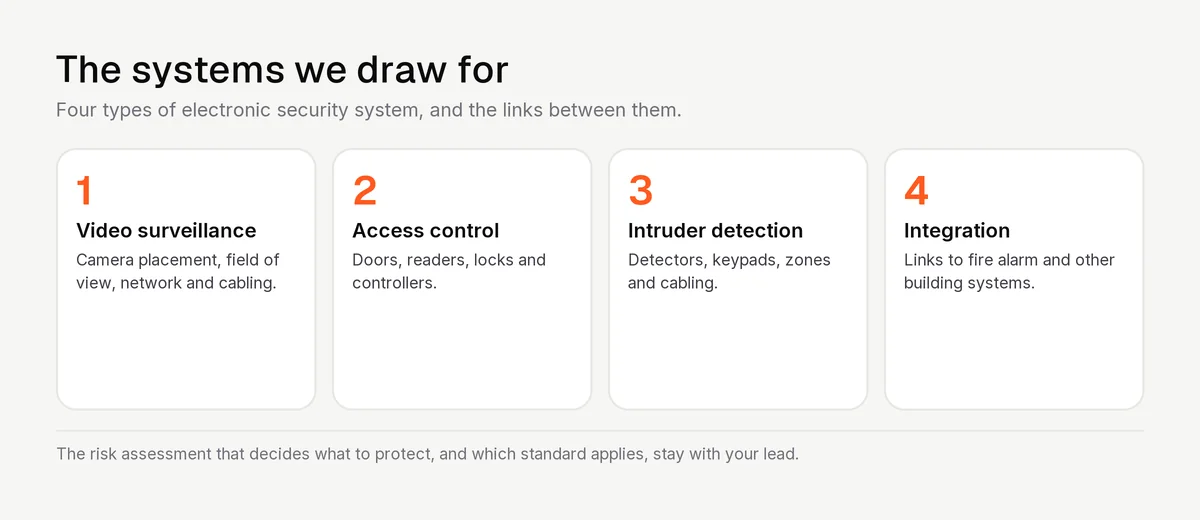
Video surveillance (CCTV)
Camera placement and field-of-view plans, mounting notes, network and cabling diagrams, and schedules.
Access control
Door schedules, reader and lock details, controller layouts and riser diagrams.
Intruder detection
Detector and keypad layouts, zones and cable schedules for alarm systems.
Integration with other systems
Interface schedules for links such as door release on a fire alarm, so the trades agree before site.
Shop drawings
Installation drawings for submittals and construction, in your template.
As-builts and closeout
Updated drawings and records that match what was installed.
Step by step,
from brief to result
What you do, what we do, and what you see at each step. You approve the plan and the quote before any work starts.
Start from your design intent
Share the risk assessment or design intent, the standards cited and your templates.
List the documents and the interfaces to other systems, so each has an owner.
A one-page document register.
Trial one area
Give one floor, one building or one system.
Draw it as a trial. Happy, you pay. Not happy, you pay nothing.
A real package to check.
Produce to your templates
Share symbols, CAD standards and software versions.
Draw, self-check against a checklist and raise questions early.
Drawings in your format and a question log.
Coordinate interfaces
Share architectural, electrical and fire-services drawings.
Check doors, power, cabling paths and fire-alarm interfaces and list conflicts for your lead.
A coordination list for your lead.
Close out
Review as-builts.
Update drawings and schedules to what was installed.
A final set and a handover note.
What you
receive
- A document register
- Camera, door and detector layouts
- Riser and system diagrams
- Cable and door schedules
- Interface schedules with other systems
- Shop drawings
- As-builts
- Daily, weekly or monthly reporting as you choose
- A short lessons log: what we learned and changed
What you
can expect
- Documents that follow your design intent
- Interfaces agreed before site
- More production capacity
- Files in your formats
These are what to expect, not guarantees. Results depend on your starting point, your market and the decisions you make. Timings are our founders' experience, and your plan states them before we start.
Experienced people,
in a founder-led, honest studio
We are a new, founder-led studio, and we say so on purpose. The experience behind it is real.
“We draw and schedule security systems under your risk assessment and your licensed people. We hold no security licence and make no claim to one.”
Check us
Read the founders' profiles, open our case studies, or run a pilot task before you pay.
Who this is
not for
We would rather say so now than after you have paid.
- You need us to carry out the risk assessment, hold a security licence, or sign off. Those stay with your licensed and registered people.
- You need installation or monitoring. We produce documents.
- You need certified-vendor status. We claim none.
Not sure? Book a free ten-minute call and we will tell you honestly.
Electronic security systems design support:
common questions
We do not publish a price for this work because every project differs. You request a quote and we send one itemised quote that you approve first.
What do electronic security systems include?
Video surveillance, electronic access control (cards, readers, door hardware), intruder detection and their integration with other building systems, such as door release on a fire alarm.
Which Australian standards apply?
It depends on the system and the project. For intruder alarm systems, AS/NZS 2201.1:2007 covers design, installation, commissioning and maintenance at the client's premises, though it does not set how much protection is required, which is a risk-assessment decision. Fire detection and alarm interfaces sit in the AS 1670 series, which the NCC 2022 lists (2018 editions). The older AS 4806 CCTV series is still cited, but its status has changed over time, so we ask which standard your project names and work to that. Check current editions with Standards Australia.
Is there a single standard for ESS drawings?
We did not find one. Documents follow your design intent, your risk assessment, the standards your project cites and your templates. That is why we agree a document register first.
Who needs a licence?
Security licensing in Australia is state-based, and the rules for installers and advisers vary. Confirm what your project and state require. We produce documents under your licensed people and do not hold or claim licences.
Do you provide sign-off?
Our team produces drawings, models and schedules under your registered or licensed design lead, who reviews the work and signs it. We do not provide engineering sign-off, registration or licences.
What does it cost?
We do not publish a price. Request a quote for one itemised quote you approve first, or start with a trial package and pay only if you are happy.
Can we verify your team?
On request we share a due-diligence pack: the delivery team's credentials, the legal documents that cover the work, the current process, and client references you can call.
Where the facts on this page come from
- Building Performance (NZ): AS/NZS 2201.1:2007 intruder alarm systems, client's premises
- IPVM forum: Australians, are you using Australian CCTV standards? (2015)
- ABCB: NCC 2022 Volume One, referenced documents (read 11 Nov 2026)
- OAIC: Australian Privacy Principles quick reference (APP 7 direct marketing, APP 8 overseas disclosure, APP 11 security)
- Proscale360: the pilot, one task, pay only if you are happy
Sources read on 11 November 2026. General information, not legal, tax, security or financial advice. We do not claim cloud-provider certifications or partner status on this page. Rules and prices change, so check the source before you rely on it.
Often needed
alongside this
Design and engineering support
Managed drafting, BIM and design support for AV, security systems and MEP. Quote only.
Audiovisual design support
AV drawings, schedules and as-builts under your design lead. Quote only.
MEP design and BIM support
BIM modelling, coordination and drawings for MEP, under your registered engineer. Quote only.
Tell us what you need.
Get one clear quote.
Describe it in a few lines. A founder reads it and replies with questions or one itemised quote that you approve before any work starts. Prefer to start small? Try the pilot: one task, and you pay only if you are happy.
- CompareAny quote, in our calculator
- Real buildProteinPlus, counted
- $145Website, from
- $0if you're not happy
- $580Online store
- You ownthe code
- 6 stepsHow we work
- AI + peopleAI builds, people test
- Your quote?We price it next to ours
Don't pay 2016 prices for software.
Give us one task. Happy, you pay. Not happy, you pay nothing. We take the risk.
See all nine campaignsWe take the risk
Give us one task. You see a working result before you decide. Happy, you pay. Not happy, you pay nothing.
How you payHow we work
A free call of about ten minutes, a free plan and one itemised quote, a pilot, your review, then go live with support. Six steps, nothing hidden.
See the six stepsPrices you can check
Website from $145. Online store $580. Custom software from $720. Send us any quote you hold and we price the same work next to it. A small upgrade (about an hour of work or less) is about $10.
See the price list“Everything is possible. It doesn't have to cost a fortune, and nothing should hold your ideas back. Things are changing, and you should know it. We have the experience in what we do, so you can do what you're good at: running your business and steering its strategy. You shouldn't have to learn digital marketing or web development, overpay, or wait months, quarters or years for a project to earn revenue.”
“Technology and coding are not as far out of reach as they seem. I have led projects for eight years, and I bring everything I have built and learned to yours. I take care of the details, the security, the updates and the technology stack, so you don't have to worry about any of it.”
In the founders' own words, lightly edited for clarity.
To be the go-to contact for any IT work, priced so clearly it feels as easy as picking something off a supermarket shelf.
We take the risks. You get the result.
Run by Alif Vasaya (Sydney) and Sabina Ansari (Ahmedabad). A new, founder-led studio, and we say so.