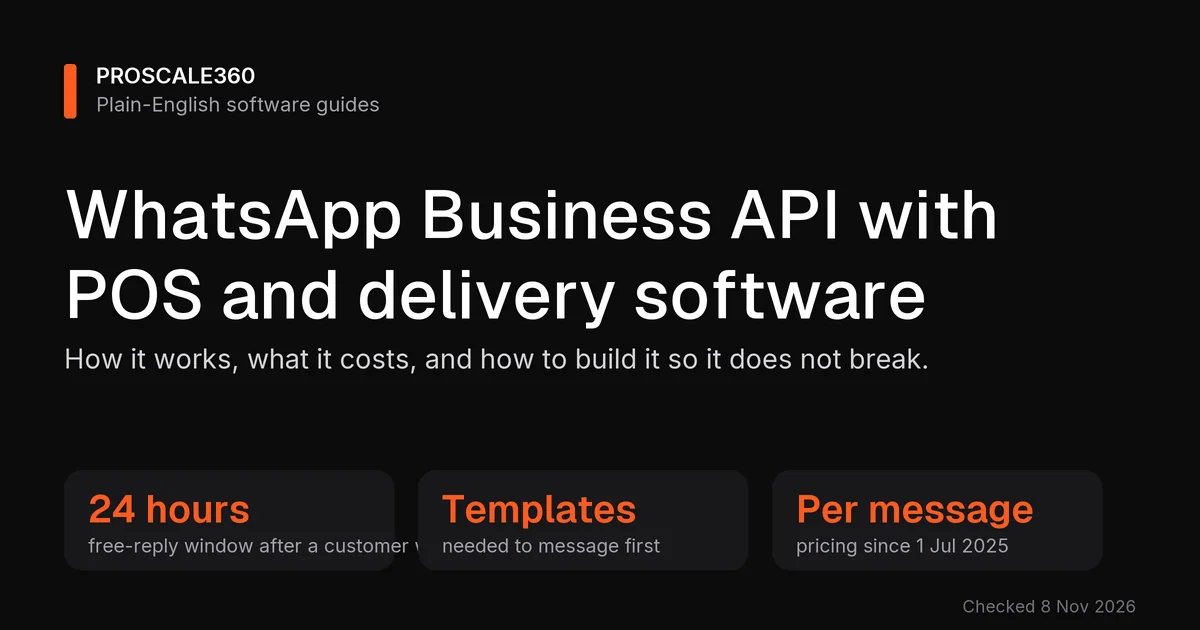
The short answer. To send WhatsApp messages from POS or delivery software you use Meta's WhatsApp Business Platform (the Cloud API). You may message a customer first only with a pre-approved template, and only if they have opted in. Once they reply, a 24-hour window opens and you can answer in free text. Since 1 July 2025 Meta charges per delivered message, with the rate set by the message category and the customer's country.
What we could not give you. The actual rate per message for Australia or India. Meta publishes those in downloadable rate cards that we could not read, so we do not quote a price. We show how to find it and how to estimate your bill.
Sourced means we read the original. Our estimate marks our own judgement. Price list means our published price.
How a delivery order talks to WhatsApp
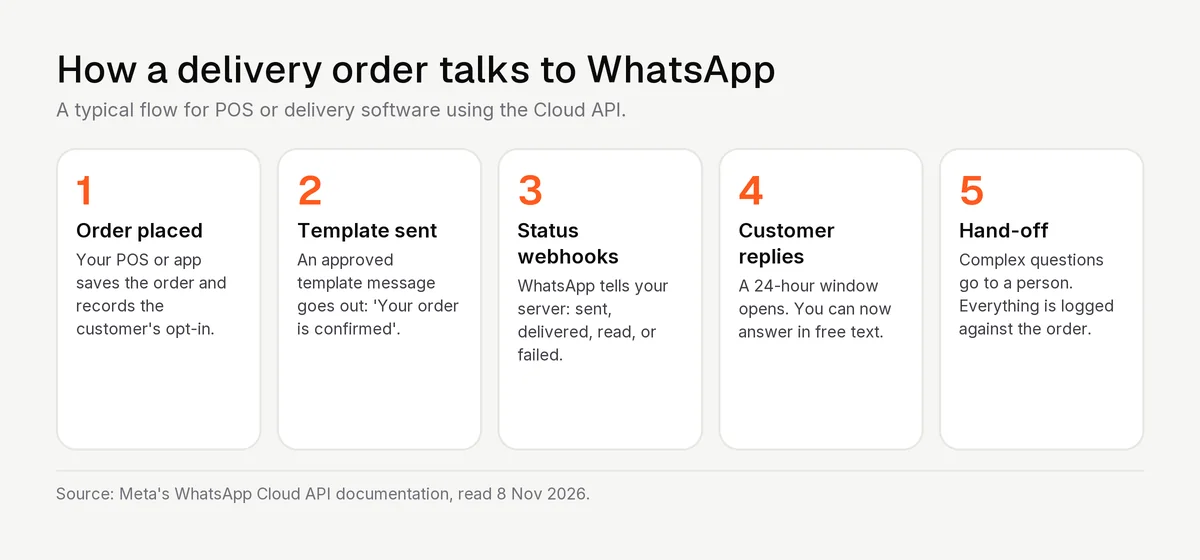
- Order placed. Your POS or delivery app saves the order. At this moment it must also record the customer's opt-in: Meta's documentation says user opt-in is required before you send template messages.
- Template sent. Your server calls the Cloud API with an approved template, such as “Your order is confirmed”. Meta says template messages generally require approval and are the only type you can send to a customer outside the 24-hour service window.
- Status webhooks. Meta calls a URL on your server with each delivery status update (sent, delivered, read, failed) and with incoming messages. Your system updates the order.
- Customer replies. A 24-hour timer starts when the customer messages you and resets on each message they send. Inside it you can send free-text replies.
- Hand-off. Anything complex goes to a person, with the conversation logged against the order.
Sourced Meta's documentation also lists what you need to set up: a business portfolio, a WhatsApp account, a messaging account for templates and billing, a business app, and access tokens with the right permissions.
What it costs
Meta's pricing page says that from 1 July 2025 it charges on a per-message basis, and only for messages that are delivered. Messages sent by the customer to you are free. The rate depends on the message category (marketing, utility and authentication for templates) and on the country calling code of the recipient. Meta changes prices only on the first of January, April, July or October, and the latest effective date on the page was 1 October 2026. Sourced
Service messages, with a conflict you should check. The developer pricing page says service messages were free from 1 November 2024 and that Meta resumed charging on 1 October 2026, with 1,000 free service messages per business phone number each month. The WhatsApp marketing site we read still said service messages are not charged. We cannot tell which is current, so check Meta's live pricing page before you budget. Sourced
Free entry-point windows also differ by page. The developer page said a free window after a customer arrives from a click-to-WhatsApp ad may stay open for up to 7 days; the marketing site said 72 hours. Again, check the live page. Sourced
How to estimate your bill. Our estimate Multiply the messages you expect in each category by the current rate for your customers' country, using Meta's downloadable rate card for the quarter. For a delivery business a rough monthly count is: orders × the number of template messages per order (for example confirmed, out for delivery, delivered), plus any marketing messages. Utility messages sent for an existing order are usually your largest bucket.
Price list Our own price for a basic WhatsApp chat widget on a website is +$30 as an extra on a site package. A full API integration with your POS or delivery software is scoped and quoted, because the work depends on your system. See the price list.
Limits to design around
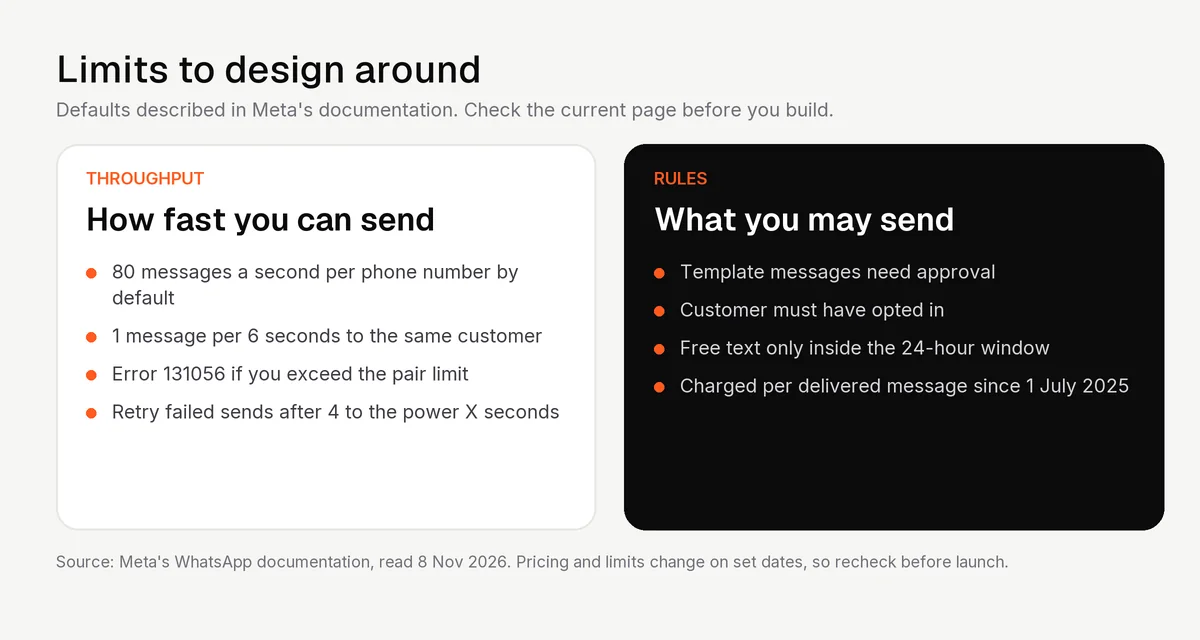
- Throughput. Meta's documentation describes a default of 80 messages a second per phone number.
- The pair limit. One message every 6 seconds to the same customer (about 600 an hour), with short bursts allowed that borrow from future quota. Exceeding it returns error 131056. For order updates, do not send five messages to one customer in one minute.
- Retries. The documentation suggests retrying failed sends after 4 to the power X seconds, starting with X at 0. That is exponential backoff. Cap the attempts and make sends idempotent so a retry cannot message the customer twice. Our guide to retries under load explains why.
- Messaging limits. There is a cap on how many unique customers you may message outside the 24-hour window in a rolling 24 hours, applied at business portfolio level.
- API request limits. The documentation lists default request limits per app that are higher for active accounts. Read the current numbers on the page.
Sourced
How to build it so it does not break
This section is our judgement from building integrated systems. Our estimate
- Use a queue between your POS and WhatsApp. The POS saves the order and drops a “send message” job on a queue; a worker sends it. If WhatsApp is slow or you hit a limit, orders are not blocked.
- Store the opt-in and the template used with the order, so you can show why a message was sent.
- Treat webhooks as unreliable. They can arrive late, twice or out of order. Update status by message ID, ignore stale updates, and respond quickly to Meta, then do the heavy work afterwards.
- Keep a fallback. If a message fails, fall back to SMS or an in-app notice for important updates such as “driver arriving”.
- Log everything against the order, including failures, so support can answer “did the customer get it?”.
- Test templates early. Approval takes time and a rejected template blocks launch.
- Watch your costs. Count messages per order and alert if the number jumps.
Connecting to your POS or ERP
The pattern is the same whether your system is a retail POS, a restaurant app or an ERP: something in that system must tell ours an order changed state (a webhook, an API call or a database change), and we turn that into the right template. If you use a specific ERP, tell us which and we will write the plan; whether it has a clean API decides the effort, and we will tell you straight if it does not. We have not described any one vendor's API here because we have not verified it for this article.
How Proscale360 is changing this
Proscale360 is a founder-led, remote-first studio: Alif Vasaya, a marketer in Sydney, and Sabina Ansari, a senior full-stack engineer and tech lead in Ahmedabad.
We want to be the go-to contact for any IT work, priced as clearly as a supermarket shelf. We take the risks. You get the result.
Founder account Between them, our founders have built integrated systems from scratch to live, including project management, ServiceNow, AI integration, and data collection and analysis, and Sabina has eight years of experience leading software projects. That is our own statement and is not independently verified. What we can show you is counted: see the ProteinPlus and Juhapura Mart case studies.
For WhatsApp work, the pilot is a good first step: choose one message, such as “order confirmed” or “out for delivery”, and we wire it up so you can judge it with your own eyes. Give us one task and review the working result. If you are happy, you pay. If you are not, you pay nothing. If you like it and want it better, you pay for our effort plus $10 for a round of tweaks and one meeting. The pilot page has the terms. Start with get a quote, or read how AI agents and automation can answer common questions once the plumbing works.
The evidence against us, and who we are not for
We are new and founder-led. There are two of us, so capacity has a ceiling, and we have two published case studies, ProteinPlus and Juhapura Mart. We are not the right choice if you need someone in your office five days a week, a 24-hour support team, or a large programme with many specialists at once.
If you need a ready-made inbox for a large support team with agent rosters and reporting, buy a customer messaging product built for that. We build the connection between your systems and WhatsApp, not a contact-centre product.
Frequently asked questions
How does the WhatsApp Business API work with POS software?
Your POS or delivery app sends events to your server, which calls Meta's Cloud API to send approved template messages. Meta sends delivery statuses and customer replies back to a webhook URL on your server, and your system updates the order.
How much does the WhatsApp Business API cost?
Since 1 July 2025 Meta charges per delivered message, with the rate set by the message category and the recipient's country. Messages from customers to you are free. We could not read the rate cards, so check Meta's current pricing page for Australia or India rates.
What is the 24-hour window?
A timer that starts when a customer messages you and resets with each message they send. Inside it you can send free-text replies. Outside it you can only send approved template messages.
Do I need template approval and opt-in?
Yes. Meta says template messages generally require approval, and that user opt-in is required before sending them. Templates are the only messages you can send outside the 24-hour window.
What are the sending limits?
Meta's documentation describes a default of 80 messages a second per number, a limit of one message per 6 seconds to the same customer, and a cap on unique customers you can message outside the window each day. Check the current page.
Can Proscale360 connect WhatsApp to our POS or ERP?
Yes, as a scoped and quoted piece of work. Tell us which system you use and we write the plan. Start with one message as a pilot: if you are happy you pay, and if not you pay nothing.
Sources
- Meta, WhatsApp Business Platform pricing, accessed 8 November 2026; effective dates up to 1 October 2026
- WhatsApp Business, Platform pricing, accessed 8 November 2026; differs from the developer page on some points
- Meta, WhatsApp Cloud API, accessed 8 November 2026
- Proscale360 price list, our own published prices
General technical information. Meta changes pricing and limits on set dates; check the current documentation before you build or budget. We did not read Meta's downloadable rate cards. Prepared by the Proscale360 team with AI assistance. Checked 8 November 2026.
We specialise in exactly this kind of project. Get a free consultation and a fixed quote.